
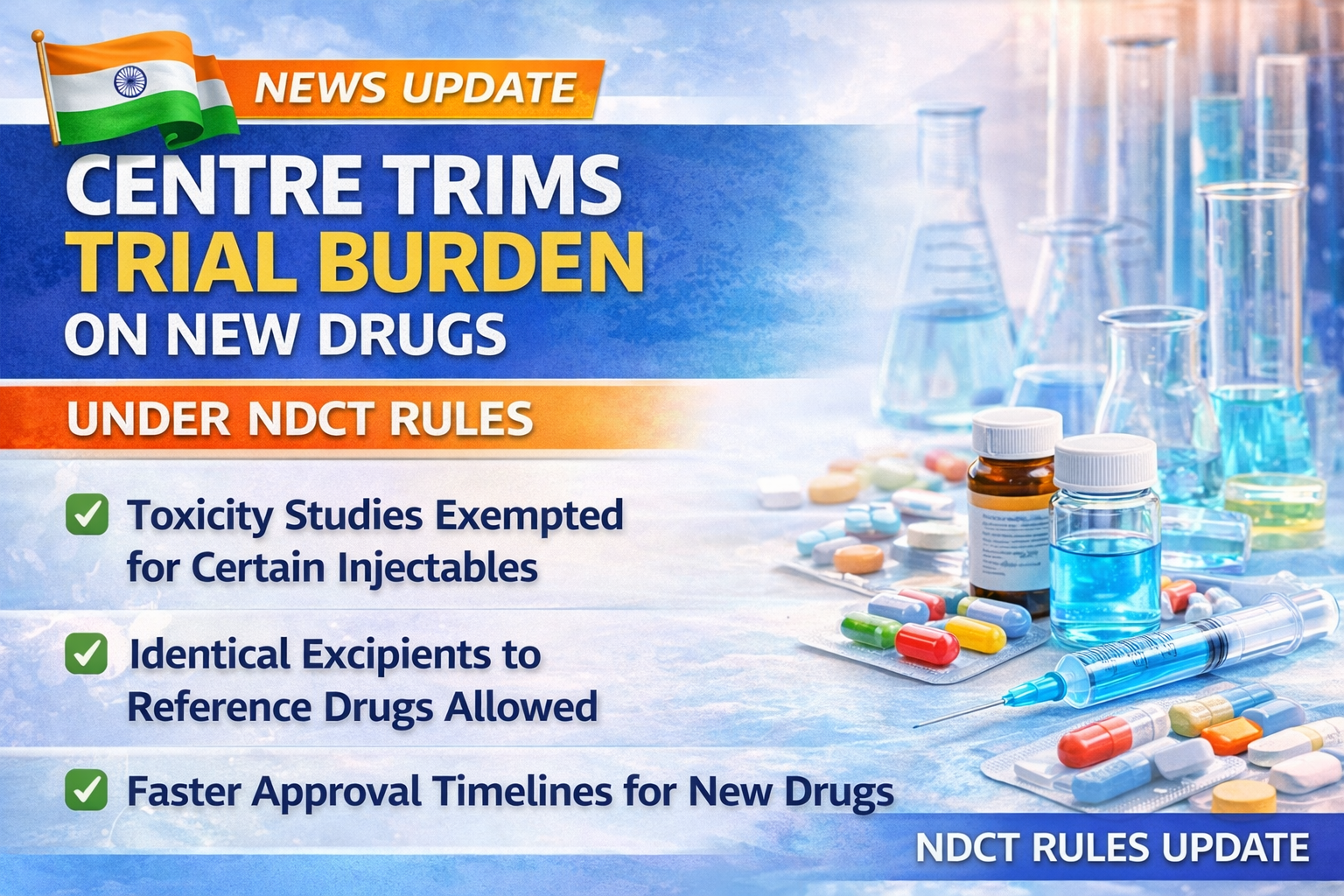
In a significant policy move aimed at simplifying drug development and easing regulatory pressure, the Union Health Ministry has proposed key amendments to the New Drugs and Clinical Trials (NDCT) Rules, 2019. The draft notification offers exemptions that could substantially reduce costs and approval timelines for manufacturers of generic injectable and intravenous medicines.
This development reflects a broader effort to promote efficiency, scientific rationality, and ease of doing business within India’s pharmaceutical ecosystem.
What the NDCT Amendment Proposes
Under the proposed changes, preclinical animal toxicity studies will be exempted for:
-
Intravenous infusions
-
Injectable formulations
Condition:
The excipients used must be qualitatively and quantitatively identical to those present in the reference (innovator) product.
The amendment is currently in the draft stage and open for public feedback for 30 days before final implementation.
Why Excipients Are Central to Drug Safety
Although excipients are pharmacologically inactive, they play a crucial role in drug formulation. They may influence:
-
Drug stability
-
Compatibility with the active pharmaceutical ingredient (API)
-
Risk of adverse reactions
Earlier regulations mandated toxicity testing to account for these interactions. However, regulators now acknowledge that when excipient composition is exactly matched, additional animal studies offer limited scientific value.
Any variation—whether in quantity or type—will continue to require toxicity testing.
Benefits for Generic and Injectable Drug Manufacturers
Reduced Development Costs
Animal toxicity studies are resource-intensive. Their exemption can significantly lower development expenses for eligible formulations.
Faster Regulatory Timelines
By eliminating redundant testing, companies can accelerate product approvals and market entry.
Stronger Market Exclusivity
This reform also benefits businesses operating under a monopoly medicine company in India model, where faster launches help establish regional exclusivity and commercial dominance.
A Strategic Step Toward Global Alignment
India’s pharmaceutical sector has long been recognized for its dominance in generics. However, lengthy regulatory processes have often limited speed and scalability. The proposed NDCT amendment aligns India’s regulatory approach with global best practices by removing scientifically unnecessary requirements while maintaining safety standards.
This shift strengthens India’s reputation as a reliable and innovation-ready pharmaceutical manufacturing hub.
BA/BE Studies Shift to a Notification-Based System
In a parallel reform, the Health Ministry has finalized the transition of Bioavailability and Bioequivalence (BA/BE) studies to a notification-based mechanism, eliminating the need for prior licensing approvals.
Key Outcomes:
-
Reduced administrative burden
-
Faster initiation of studies
-
Improved regulatory efficiency
Currently, the Central Drugs Standard Control Organization (CDSCO) processes thousands of BA/BE applications annually. This new system is expected to significantly cut procedural delays.
The amendment is scheduled to take effect from April this year.
Positive Implications for Contract Manufacturing
These regulatory reforms create strong growth opportunities for organizations operating as a pharma contract manufacturing company.
With simplified compliance and faster approvals, contract manufacturers can:
-
Scale injectable and IV product portfolios
-
Meet domestic and export demand efficiently
-
Attract global pharmaceutical outsourcing projects
Industry Response and Expert Views
Regulatory experts and clinical professionals have largely welcomed the move, citing:
-
Reduced reliance on animal testing
-
Faster access to affordable medicines
-
Improved predictability in regulatory approvals
Although the exact financial savings may vary, the overall reduction in time-to-market is expected to be substantial.
Conclusion
The Centre’s decision to ease trial requirements under the NDCT framework marks a forward-looking transformation in India’s pharmaceutical regulation. By exempting qualifying injectable drugs from toxicity studies and simplifying BA/BE approvals, the government is fostering a more agile, cost-effective, and innovation-friendly environment.
As these reforms take effect, they are set to reinforce India’s leadership in generics, contract manufacturing, and monopoly-based pharma distribution models—while upholding global quality and safety standards.