
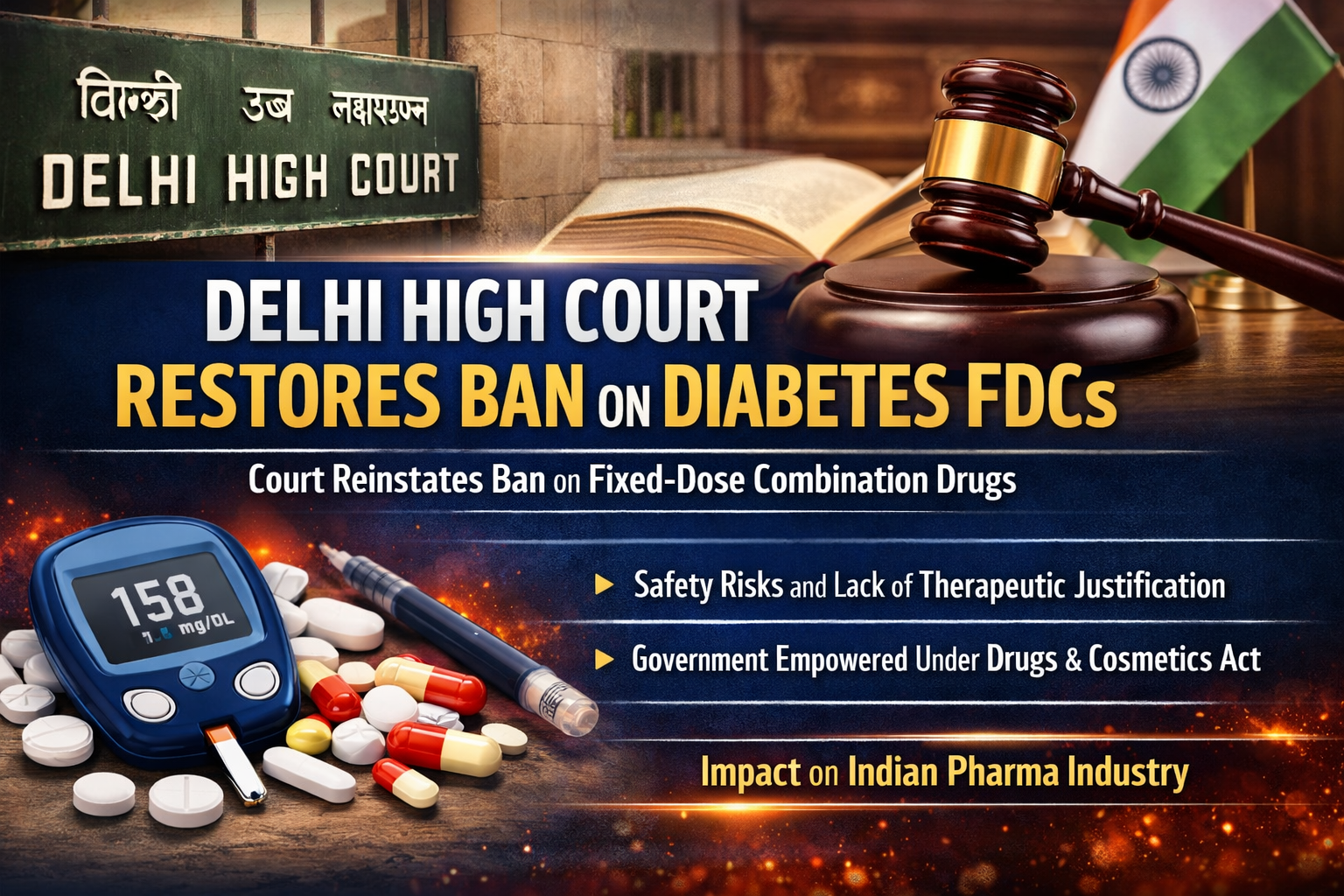
The Delhi High Court has delivered a significant judgment impacting the Indian pharmaceutical industry by restoring the ban on two fixed-dose combination (FDC) drugs used in the treatment of Type II Diabetes Mellitus. This ruling reinforces the Central Government’s regulatory authority under the Drugs and Cosmetics Act, 1940, and reiterates the precautionary approach adopted in matters concerning public health and drug safety.
Background of the Case
In 2018, the Central Government issued notifications prohibiting the manufacture and sale of specific anti-diabetic FDCs containing combinations of Glimepiride, Pioglitazone, and Metformin in certain strengths. These combinations were widely manufactured and marketed by multiple pharmaceutical companies.
However, in February 2019, a single judge of the Delhi High Court quashed these notifications, allowing manufacturers to continue producing and selling these drugs. This relief was granted based on petitions filed by several pharmaceutical companies involved in the production of these formulations.
Division Bench Overturns the 2019 Order
On January 15, 2026, a division bench of the Delhi High Court overturned the 2019 ruling and restored the ban on the two diabetes FDCs. The bench held that the Central Government acted well within its statutory powers under Section 26A of the Drugs and Cosmetics Act, 1940, which authorizes the prohibition of drugs that pose potential risks to human health or lack therapeutic justification.
The court emphasized that judicial forums are not equipped to independently evaluate complex scientific and pharmacological data, especially when expert bodies have already examined such matters.
Key Legal Observations by the Court
The division bench made several important observations that are likely to have far-reaching implications:
-
Precautionary Principle: The court clarified that Section 26A does not require proof of actual harm. A likely or foreseeable risk to human health is sufficient to justify regulatory intervention.
-
Role of Expert Bodies: Once expert committees, such as those constituted under statutory frameworks, assess safety and risk, courts should not substitute these findings with their own interpretations.
-
Limits of Judicial Review: The court noted that determining appropriate dosages and therapeutic justifications involves specialized scientific expertise, which lies outside the institutional competence of the judiciary.
Basis of the Government’s Ban
The ban was imposed following recommendations from a sub-committee of the Drug Technical Advisory Board (DTAB). The expert body concluded that the concerned FDCs involved potential risks to patients and lacked adequate safety and therapeutic justification. These findings formed the foundation for the government’s 2018 notifications.
Impact on the Pharmaceutical Industry
This judgment is a reminder that regulatory compliance and scientific validation are critical in the formulation and commercialization of FDCs. Pharmaceutical companies must ensure that all combinations have clear therapeutic rationale and safety data, especially in chronic conditions like diabetes where long-term drug exposure is common.
The ruling may also prompt companies to reassess their product portfolios and focus on safer, well-justified formulations. In this evolving regulatory environment, many manufacturers are exploring alternative business models such as working with a monopoly medicine company in India to reduce competitive risks while maintaining compliance.
Additionally, companies are increasingly collaborating with a pharma contract manufacturing company to ensure quality, regulatory adherence, and cost efficiency without bearing the full burden of manufacturing infrastructure.
Broader Regulatory Significance
The decision strengthens the government’s ability to act proactively in safeguarding public health. It sends a clear message that commercial considerations cannot override patient safety and that expert-driven regulatory decisions will receive judicial deference when made within the bounds of law.
Conclusion
The Delhi High Court’s restoration of the ban on certain Type II diabetes FDCs underscores the importance of scientific rigor, regulatory oversight, and the precautionary principle in India’s pharmaceutical landscape. For industry stakeholders, the judgment serves as both a caution and an opportunity—to innovate responsibly, align with expert guidance, and adopt sustainable business models. In this context, companies like DM Pharma Global, operating with a strong focus on quality, compliance, and ethical practices, are better positioned to navigate the evolving regulatory framework and contribute meaningfully to public health.