
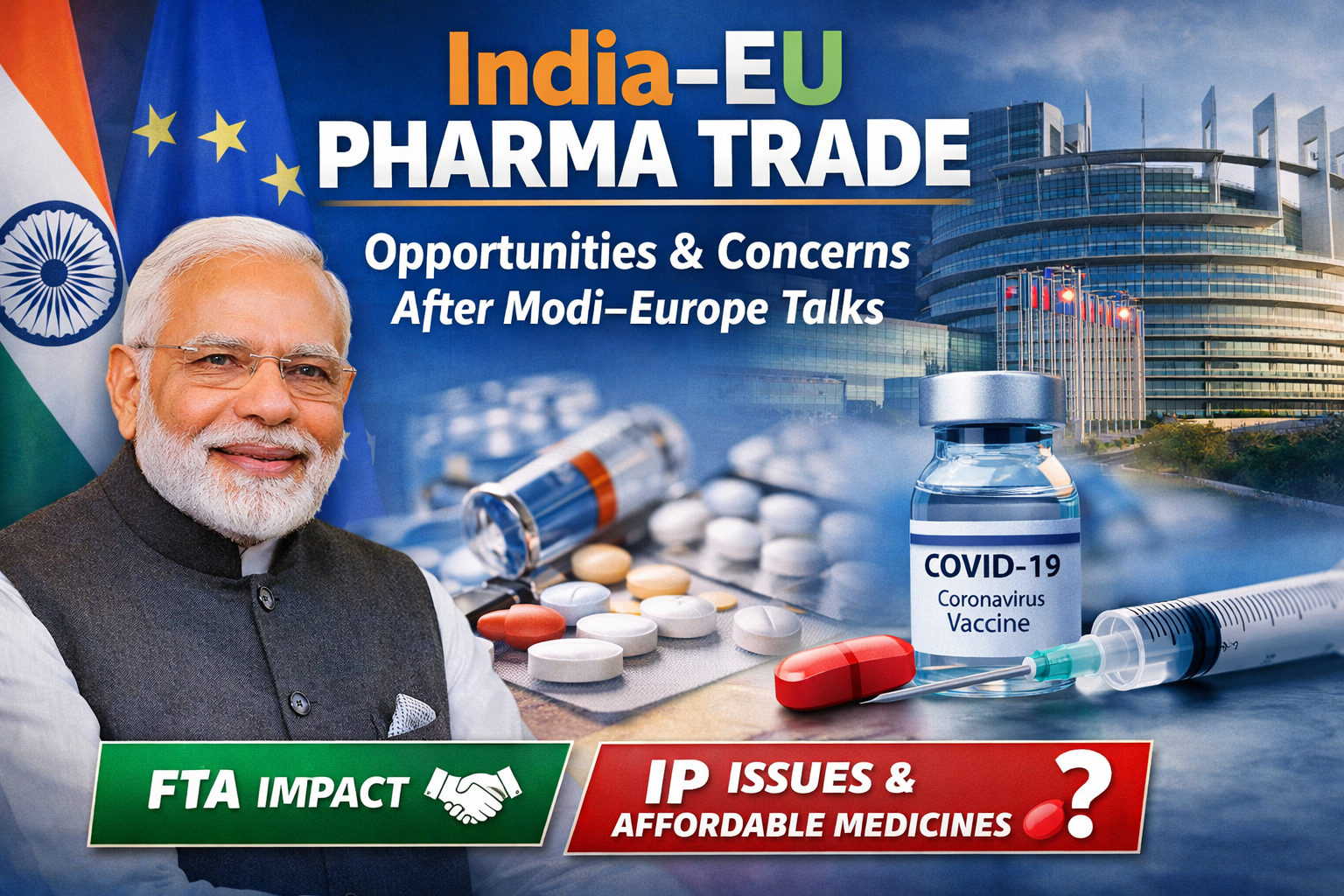
The evolving pharma trading relationship between India and Europe has entered a critical phase following Prime Minister Narendra Modi’s meetings with European ministers and the advancement of the India–EU Free Trade Agreement (FTA). While the proposed pact promises expanded market access, smoother regulatory cooperation, and higher trade volumes, it has also triggered serious concerns from patient advocacy groups about intellectual property (IP) protections and their potential impact on affordable medicines.
This blog examines the strategic upside for pharma trade, alongside the public health safeguards India must preserve to maintain its global role as the pharmacy of the world.
India–Europe Pharma Trade: Strategic Importance
India is a cornerstone of the global pharmaceutical supply chain, particularly for generic medicines and APIs. European countries, on the other hand, represent a high-value, tightly regulated market with strong demand for cost-effective and quality-assured medicines. Strengthening pharma trade between India and Europe can:
-
Improve availability of affordable generics in Europe
-
Expand export opportunities for Indian manufacturers
-
Enable joint research, biosimilar development, and contract manufacturing
-
Reduce dependency on limited global API sources
The recent diplomatic engagements between India and the EU leadership have reinforced the intent to deepen economic cooperation, with pharmaceuticals positioned as a priority sector.
India–EU FTA: What’s at Stake for Pharmaceuticals?
The proposed India–EU Free Trade Agreement goes beyond tariffs and market access. It establishes high standards for IP protection and enforcement, covering copyrights, trademarks, designs, trade secrets, and plant variety rights. While these protections can encourage innovation and cross-border investment, they raise red flags when applied to medicines.
Patient advocacy groups argue that even indirect IP provisions—if drafted broadly—can delay the entry of affordable generics, especially for complex drugs like biologics.
Patient Groups Call for Transparency and Parliamentary Scrutiny
A leading patient advocacy body, the Working Group on Access to Medicines and Treatment, has urged the Indian government to make the full FTA text public and place it before Parliament for detailed debate prior to signing.
According to the group, such scrutiny is essential to understand how the agreement may affect:
-
India’s patent framework
-
Regulatory approval timelines
-
Data exclusivity norms
-
Long-term access to affordable medicines
The concern is not merely domestic. India supplies affordable generics to low- and middle-income countries worldwide, meaning any weakening of India’s patent safeguards could have global public health consequences.
TRIPS vs TRIPS-Plus: The Core Concern
At the heart of the debate is the fear of TRIPS-plus provisions. Under the WTO’s TRIPS Agreement, countries are required to meet minimum standards of IP protection. TRIPS-plus measures go beyond these obligations and may include:
-
Patent term extensions
-
Pharmaceutical data exclusivity
-
Additional forms of market exclusivity
Patient groups caution that such provisions—if included explicitly or implicitly—could delay generic competition, raise medicine prices, and limit treatment options.
While EU communications on the FTA reportedly do not mention patent-specific clauses, they also do not clearly rule out controversial TRIPS-plus measures. This ambiguity has intensified calls for clarity.
Lessons from Past Negotiations
History plays a crucial role in shaping the current discourse. When India–EU negotiations were active between 2007 and 2013, India firmly rejected EU demands for patent term extensions and data exclusivity following strong resistance from civil society and public health advocates.
Similarly, when negotiations were revived in 2022, the EU initially proposed IP provisions that again sought extended protection for pharmaceutical products. Advocacy groups warn against repeating approaches seen in some recent FTAs that could directly or indirectly restrict access to affordable medicines.
Interestingly, newer EU agreements—such as the EU–Mercosur pact—indicate a shift away from patent-related TRIPS-plus provisions. Experts argue that this precedent should guide the India–EU FTA as well.
Balancing Trade Growth and Public Health
From a trade perspective, the India–EU FTA could significantly boost pharma exports, manufacturing partnerships, and technology exchange. For Indian companies, easier access to Europe means scale, credibility, and long-term growth.
However, from a public health standpoint, India must ensure that:
-
Its patent laws remain intact
-
Generic competition is not delayed
-
Regulatory flexibility for public health emergencies is preserved
A well-balanced agreement can support innovation without undermining affordability—a principle India has long defended at global forums.
The Road Ahead
As India and Europe move closer to finalizing the FTA, transparency and stakeholder consultation will be decisive. Making the agreement text public and enabling informed parliamentary debate can help align trade ambitions with India’s commitment to affordable healthcare.
The outcome of these negotiations will not only shape India–Europe pharma trading, but also determine how effectively India can continue serving millions of patients across the world.
Conclusion
Prime Minister Modi’s engagement with European ministers marks a turning point in India–EU pharmaceutical relations. While the proposed FTA offers major economic and strategic benefits, it also demands careful scrutiny to avoid unintended consequences for access to medicines.
For India, the challenge is clear: expand global pharma trade without compromising its role as the world’s most reliable source of affordable medicines. A transparent, balanced, and health-sensitive FTA is the only sustainable path forward.