
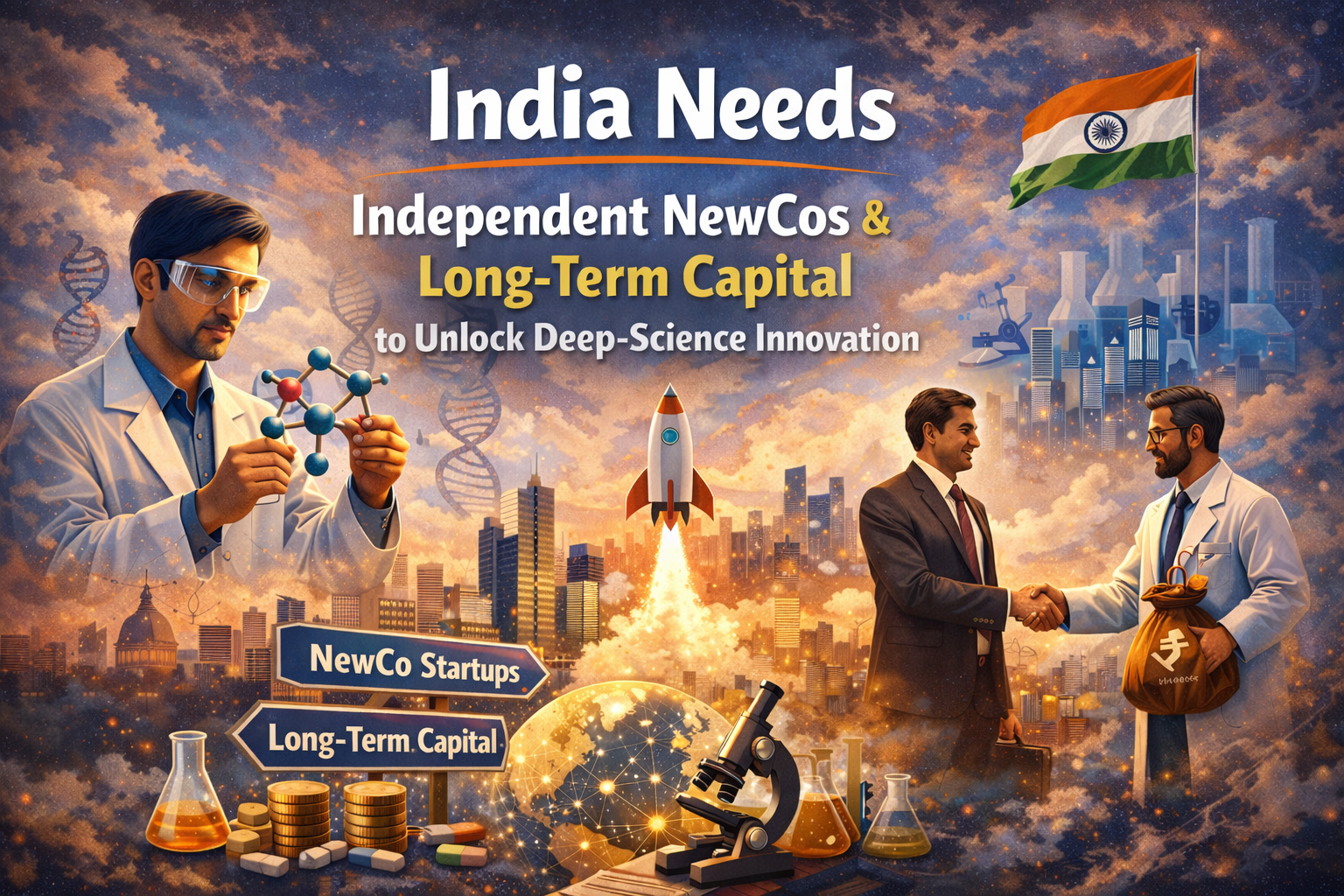
India’s pharmaceutical industry has built a formidable reputation in generics, contract manufacturing, and global supply capabilities. However, when it comes to deep-science innovation—novel drug discovery, advanced biologics, and emerging therapeutic platforms—the ecosystem still faces structural challenges. Experts at a recent industry summit emphasized that India must adopt independent “NewCo” models and attract long-term patient capital to truly unlock its next wave of pharmaceutical innovation.
The Innovation Paradox in Indian Pharma
India produces high-quality science. Academic institutions, biotech startups, and R&D divisions within pharma companies generate promising data and breakthrough concepts. Yet, many of these innovations fail to reach clinical or commercial milestones.
The key issue is not scientific capability—it is execution discipline and capital alignment.
Large pharmaceutical organizations often operate with:
-
Short-to-medium term revenue expectations
-
Risk-averse governance structures
-
Layered decision-making processes
-
Prioritization of near-market generics over high-risk discovery
As a result, early-stage deep-science projects frequently lose momentum, funding, or strategic backing.
Why Independent “NewCo” Structures Matter
A “NewCo” refers to a structurally independent entity carved out to pursue a specific innovation, asset, or therapeutic platform. Unlike traditional in-house R&D divisions, NewCos operate with:
-
Independent management teams
-
Dedicated capital allocation
-
Clear asset-level accountability
-
Strategic freedom to pivot
This model separates high-risk innovation from the financial pressures of established revenue businesses.
Advantages of the NewCo Model
-
Focused Capital Deployment
Funds are ring-fenced for a defined scientific program, preventing dilution of resources. -
Aligned Incentives
Equity participation and milestone-based funding align founders, scientists, and investors. -
Agile Decision-Making
Smaller leadership teams enable faster regulatory, clinical, and partnership decisions. -
Strategic Partnerships
NewCos can partner globally without internal conflicts or competing portfolio priorities.
For India to compete in novel drug discovery and advanced therapeutics, structural independence is not optional—it is essential.
The Role of Long-Term Capital
Deep-science innovation requires capital that understands scientific risk and long gestation cycles. Unlike generics manufacturing, drug discovery timelines often exceed 8–12 years from concept to commercialization.
Challenges in the Current Funding Landscape
-
Preference for revenue-generating models
-
Limited domestic venture capital focused on life sciences
-
Conservative risk appetite among traditional investors
-
Inconsistent follow-on funding for early-stage biotech
Without long-term, patient capital, even scientifically robust programs stall at preclinical or early clinical phases.
What Long-Term Capital Enables
-
Sustained multi-phase clinical trials
-
Advanced platform technology development
-
Global regulatory strategy execution
-
Talent acquisition in translational science
In mature ecosystems such as the US and Europe, biotech thrives because capital partners understand binary risk events and scientific milestones. India must cultivate a similar capital ecosystem.
Bridging Science and Commercialization
Even when scientific breakthroughs occur, translation into commercial success requires operational rigor. Deep-science companies must balance:
-
Regulatory compliance
-
Manufacturing scalability
-
Intellectual property protection
-
Market access strategy
Execution gaps—not scientific weaknesses—often determine survival.
This is where structured governance, milestone-based funding, and board-level scientific expertise become critical. Independent NewCos, backed by disciplined capital partners, can create this alignment.
Implications for the Broader Pharma Ecosystem
While deep-science innovation operates at the frontier, its ripple effects impact the entire pharmaceutical value chain. From discovery to distribution, a stronger innovation backbone elevates India’s global positioning.
For example, established players—including regional networks such as pcd pharma companies in chandigarh—benefit indirectly when breakthrough therapies expand therapeutic categories and create new demand pools.
Similarly, companies operating under exclusive distribution models—such as a monopoly medicine company in india structure—can leverage differentiated products originating from innovative pipelines.
In this way, innovation and commercialization ecosystems are interdependent rather than isolated.
Structural Reforms India Must Prioritize
To build a globally competitive innovation engine, India should focus on the following reforms:
1. Dedicated Innovation Funds
Government-backed and private life-science funds focused specifically on deep-science assets.
2. Tax Incentives for R&D Spin-Offs
Encouraging pharmaceutical majors to spin out assets into NewCos without punitive financial implications.
3. Stronger Academia-Industry Linkages
Translational research centers bridging laboratory science and clinical validation.
4. Regulatory Acceleration Pathways
Clear, predictable, and time-bound approval frameworks for innovative therapies.
5. Talent Retention Programs
Attracting Indian-origin scientists and biotech entrepreneurs from global ecosystems.
Risk Appetite: The Cultural Shift Required
Beyond capital and structure, India’s pharma sector must evolve culturally. Innovation demands comfort with uncertainty. Failure rates in drug discovery are high; however, portfolio-level success compensates for individual setbacks.
Large pharmaceutical corporations must:
-
Separate innovation risk from core business metrics
-
Reward long-term value creation
-
Encourage scientific entrepreneurship
This cultural recalibration is as important as financial reform.
The Strategic Opportunity Ahead
India stands at an inflection point. Its strengths in manufacturing, cost efficiency, and regulatory compliance provide a stable foundation. What remains is the structural courage to back deep science.
Independent NewCos can:
-
De-risk innovation for parent companies
-
Attract global strategic investors
-
Enable focused asset monetization
-
Accelerate India’s transition from “pharmacy of the world” to “innovation engine of the world”
With aligned capital, disciplined execution, and regulatory clarity, India can become a global hub for advanced therapeutics, biologics, and platform-driven innovation.
Conclusion
The path to unlocking deep-science innovation in India lies in structural independence and patient capital. Science alone is not enough; execution frameworks and capital alignment determine survival. By adopting NewCo models, strengthening funding mechanisms, and fostering a risk-tolerant culture, India can transform its pharmaceutical ecosystem into a global innovation powerhouse.
The opportunity is significant. The question is whether stakeholders are prepared to build the financial and structural architecture required to sustain it over the long term.