
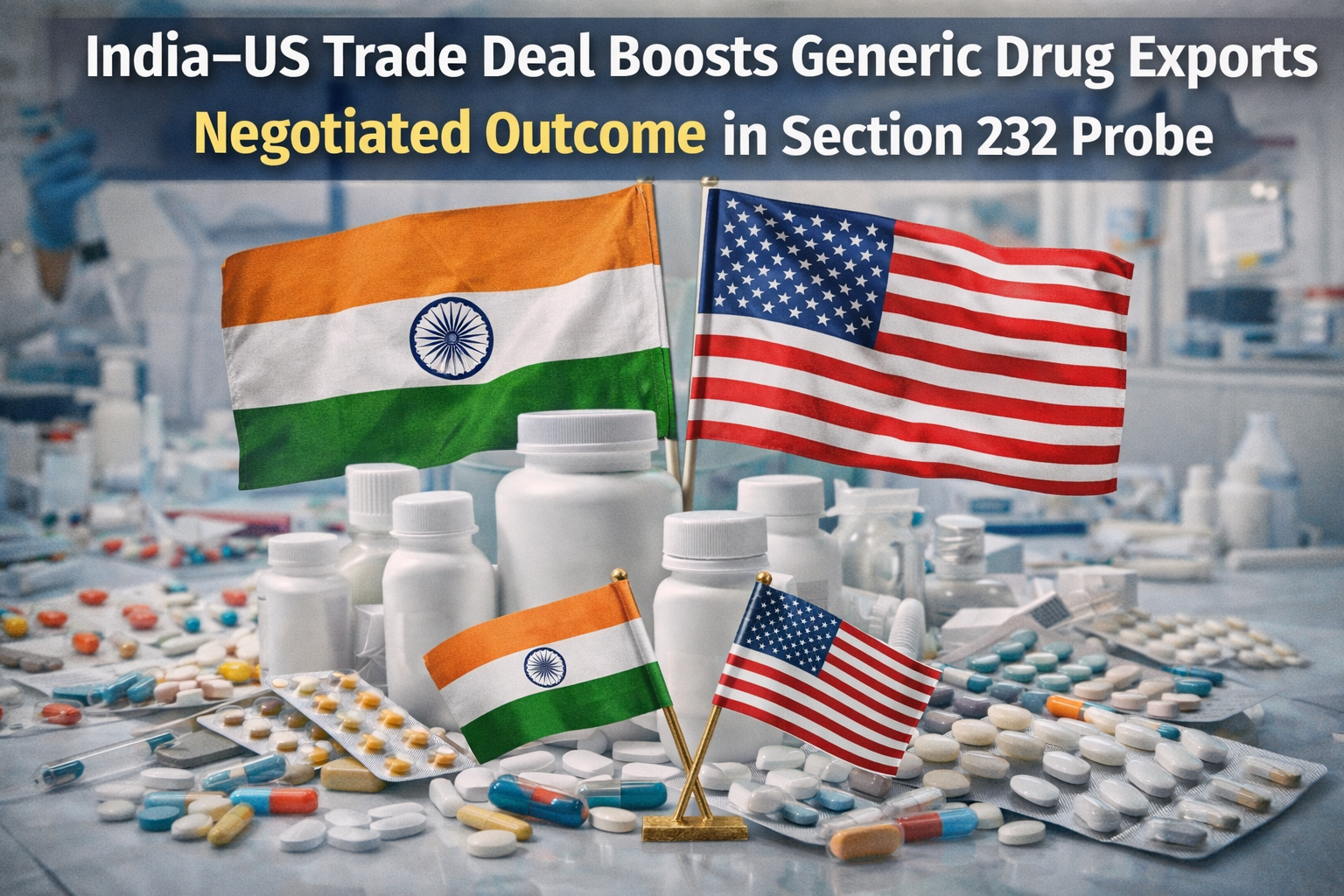
India’s pharmaceutical sector, particularly its globally competitive generic drug industry, has received a major boost following progress under the India–US trade framework. As part of the ongoing discussions, Indian generic pharmaceutical exports will receive a “negotiated outcome” under the United States’ Section 232 investigation, which examines whether certain imports pose a national security risk.
This development is being widely viewed as a positive and stabilising step for one of India’s most important export-driven industries, helping safeguard market access, pricing stability, and long-term trade relations between the two countries.
What Is the Section 232 Investigation?
Section 232 of U.S. trade law allows the American administration to restrict imports, including through tariffs or quotas, if those imports are found to threaten national security. While traditionally applied to sectors such as steel and aluminium, the scope of the investigation has expanded to include pharmaceuticals, given their importance to healthcare resilience and supply chains.
The probe, launched last year, placed global pharmaceutical exporters under scrutiny. For India—one of the world’s largest suppliers of generic medicines—this raised concerns about potential tariffs, cost escalation, and supply disruptions in the U.S. market.
“Negotiated Outcome” for Indian Generics Explained
Under the newly agreed interim trade framework, India will continue to enjoy existing exemptions for generic medicines while also receiving negotiated outcomes for:
-
Generic pharmaceutical formulations
-
Active Pharmaceutical Ingredients (APIs)
-
Excipients and other critical inputs
This approach ensures that instead of facing unilateral trade restrictions, Indian pharmaceutical exports will be addressed through bilateral negotiation, offering predictability and continuity.
Industry stakeholders see this as a pragmatic solution that balances U.S. national security concerns with the reality of its heavy reliance on affordable imported medicines.
Why This Matters for India’s Pharma Industry
The announcement holds particular importance because the United States is India’s largest pharmaceutical export destination, accounting for nearly 35% of total pharma exports.
India’s pharmaceutical export profile is dominated by generics, which operate on thin margins and depend heavily on scale, efficiency, and tariff-free access. Any abrupt trade barrier could have disrupted:
-
Price stability in the U.S. healthcare system
-
Supply continuity for essential medicines
-
Commercial viability for Indian exporters
By opting for a negotiated path, both countries reduce the risk of market shocks.
Export Performance Snapshot
Despite global uncertainties, India’s pharmaceutical exports have shown resilience:
-
Between April and November 2025, India exported pharmaceutical goods worth over $5.8 billion, including formulations, APIs, and vaccines.
-
This represented only a marginal decline of 0.18% compared to the same period in the previous year.
-
In November 2025 alone, pharmaceutical exports to the U.S. stood at $669 million, marking an 11% year-on-year increase.
These figures highlight the underlying strength of India’s pharma supply chain, even amid regulatory and geopolitical challenges.
Backbone of the U.S. Generic Drug Supply
Indian pharmaceutical manufacturers play a critical role in the U.S. healthcare ecosystem:
-
Over 45% of generic medicines by volume in the U.S. are manufactured in India
-
Around 15% of biosimilars used in the U.S. also originate from Indian facilities
More importantly, Indian generics have delivered enormous cost savings. Over the past decade, they have saved the U.S. healthcare system more than $1.3 trillion, including approximately $216 billion in 2024 alone. These savings help keep treatments affordable for millions of patients.
Industry Reaction and Policy Alignment
Industry bodies have welcomed the announcement, noting that generics remain exempt from tariffs even as broader pharmaceutical imports stay under investigation. This approach aligns with how the U.S. has treated pharmaceuticals under other free trade agreements.
Last year, Indian pharma associations had urged the government to seek exemptions for generics, warning that tariffs could:
-
Disrupt essential medicine supply chains
-
Increase healthcare costs in the U.S.
-
Undermine India’s position as a reliable supplier
The negotiated outcome appears to address many of these concerns.
What About Innovative Drugs?
While generics have gained clarity, the outlook for innovative and patented medicines remains less certain. These products, developed and marketed by a small number of global players, may still face scrutiny depending on how the final agreement is structured.
Industry experts are awaiting the detailed fine print of the interim deal to fully assess its implications across different pharmaceutical segments.
Strategic Implications Going Forward
The India–US trade understanding reinforces several long-term trends:
-
Recognition of India as a trusted partner in global healthcare supply chains
-
Growing emphasis on trade diplomacy over protectionism
-
Increased policy certainty for manufacturers planning investments and capacity expansion
For Indian pharmaceutical companies, the agreement provides confidence to continue scaling exports while maintaining compliance with evolving regulatory expectations.
Conclusion
The decision to grant India’s generic drugmakers a negotiated outcome under the Section 232 probe marks a crucial win for the industry. It protects export momentum, supports pricing stability, and ensures uninterrupted access to affordable medicines for U.S. patients.
As discussions progress and the final agreement takes shape, the development underscores the strategic importance of India’s pharmaceutical sector—not just as an export engine, but as a cornerstone of global public health.