
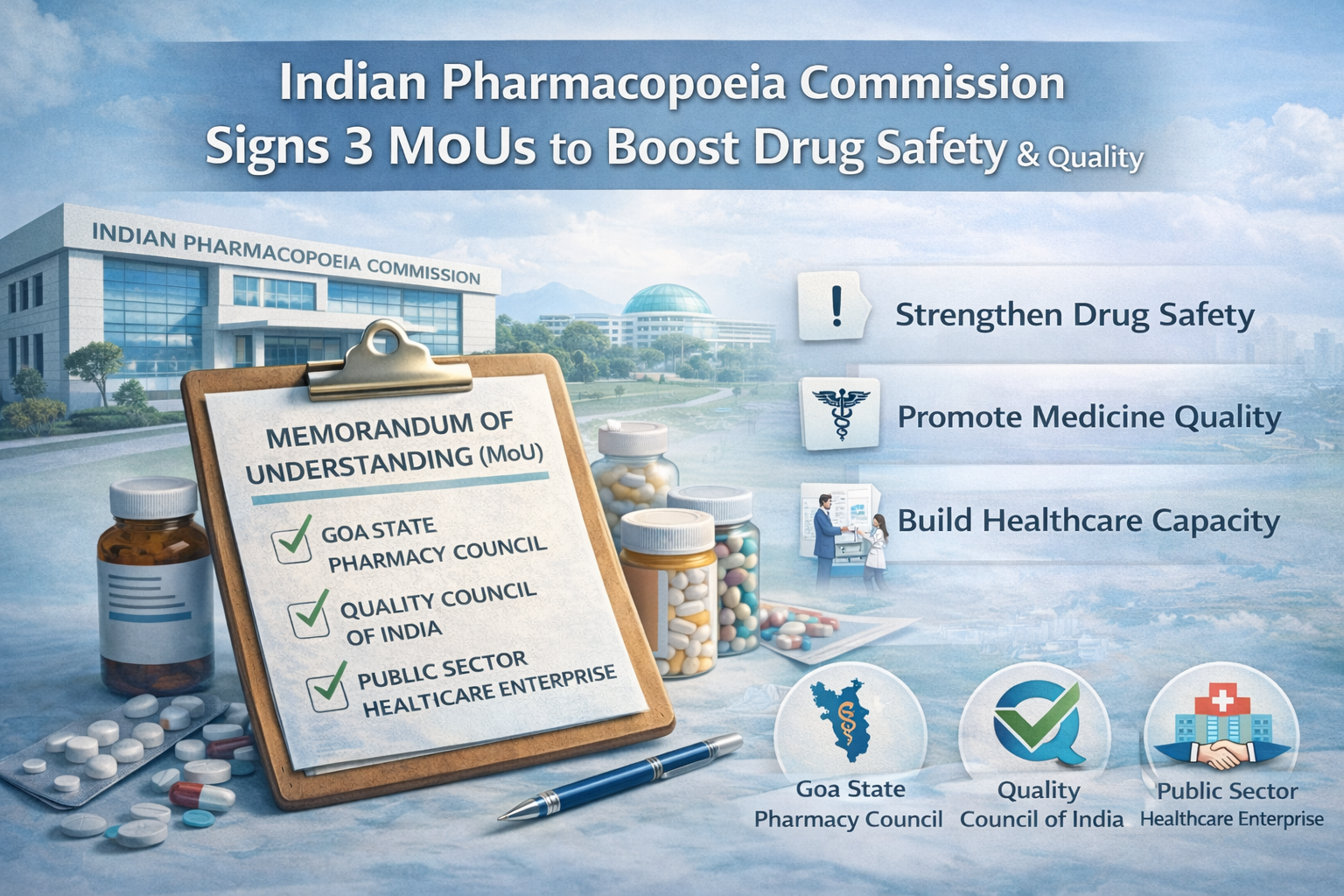
In a major development for India’s healthcare regulatory framework, the Indian Pharmacopoeia Commission (IPC) has signed three Memoranda of Understanding (MoUs) aimed at enhancing drug safety, improving pharmacovigilance systems, and reinforcing quality assurance standards across the country.
These agreements are designed to build stronger institutional collaboration between regulatory authorities, professional councils, quality bodies, and public sector healthcare institutions to ensure safer medicines and better patient outcomes.
Strategic Focus: Drug Safety and Quality Standardisation
The IPC, functioning under the Ministry of Health and Family Welfare, plays a central role in establishing official drug standards in India. The newly signed MoUs are part of a broader strategy to:
-
Strengthen pharmacovigilance systems
-
Promote rational use of medicines
-
Improve pharmacist training and professional competency
-
Enhance adverse drug reaction (ADR) reporting mechanisms
-
Standardise medicine quality across states
As India continues to expand its pharmaceutical production and healthcare services, strengthening regulatory oversight has become increasingly critical.
Collaboration to Promote Pharmacovigilance and Rational Medicine Use
One of the agreements establishes a structured framework to improve pharmacovigilance at the state level. The collaboration focuses on:
-
Promotion of the National Formulary of India among pharmacists
-
Strengthening ADR Monitoring Centres
-
Conducting workshops and professional training programmes
-
Creating awareness regarding drug safety and pharmacopoeial standards
-
Improving systematic reporting and documentation practices
Pharmacovigilance plays a vital role in detecting, assessing, and preventing adverse effects related to medicines. Strengthening ADR monitoring ensures that real-world safety data contributes to better regulatory decisions and improved patient protection.
Expanding Adverse Drug Reaction Monitoring Infrastructure
The MoUs aim to support the establishment and reinforcement of ADR Monitoring Centres across healthcare facilities. These centres are essential for:
-
Collecting safety data from hospitals and pharmacies
-
Reporting suspected adverse reactions
-
Enhancing data transparency
-
Supporting evidence-based healthcare regulation
Improved reporting systems will help identify potential risks early and ensure timely corrective actions, thereby protecting public health.
Advancing Quality Promotion and Capacity Building
Another agreement focuses on quality promotion and institutional capacity building. The objectives include:
-
Joint planning and execution of training programmes
-
Public health awareness campaigns related to medicine safety
-
Utilisation of technical expertise and institutional resources
-
Development of collaborative projects aligned with national quality standards
This flexible framework allows institutions to work together on project-based initiatives that contribute to healthcare quality improvement without imposing rigid operational constraints.
Strengthening Healthcare Infrastructure and Regulatory Support
The third MoU is aimed at enhancing infrastructure support and technical cooperation within the healthcare ecosystem. This includes:
-
Capacity-building initiatives
-
Support for regulatory implementation
-
Strengthening supply chain quality management
-
Infrastructure development for quality testing and monitoring
By integrating regulatory, professional, and infrastructure-focused efforts, the initiative promotes a comprehensive approach to pharmaceutical governance.
Regulatory Sector’s Role in Public Health
Senior officials have emphasised the importance of the regulatory sector in strengthening primary and secondary healthcare delivery across India. These MoUs are considered foundational steps toward deeper institutional partnerships that can deliver measurable improvements in:
-
Drug safety awareness
-
Quality compliance
-
Professional accountability
-
Patient safety standards
Authorities have also stressed that such agreements must move beyond symbolic documentation and translate into actionable outcomes.
Why This Initiative Is Significant for India
India is one of the world’s largest producers of medicines, supplying both domestic and international markets. Ensuring strict quality assurance and pharmacovigilance systems is essential to maintain public trust and global credibility.
The recent MoUs are significant because they:
-
Promote uniform pharmacopoeial standards
-
Encourage systematic ADR reporting
-
Strengthen pharmacist engagement
-
Support rational prescribing practices
-
Reinforce healthcare quality governance
These steps align with global best practices in medicine regulation and patient safety frameworks.
Focus on Pharmacist Awareness and Professional Development
Pharmacists serve as a critical link between patients and medicines. Enhancing their professional knowledge in areas such as:
-
Drug safety reporting
-
Rational dispensing practices
-
National formulary standards
-
Ethical pharmacy operations
will directly contribute to safer therapeutic outcomes.
Regular training programmes and workshops are expected to upgrade competencies and foster a culture of compliance and vigilance within the profession.
Future Outlook: Building a Robust Drug Safety Ecosystem
With increasing medicine consumption and expanded healthcare access, India requires a strong, data-driven drug safety infrastructure. The collaborative model adopted through these MoUs signals a shift toward:
-
Integrated regulatory systems
-
Decentralised safety monitoring
-
Continuous professional education
-
Evidence-based policy implementation
If executed effectively, these initiatives can significantly strengthen India’s pharmaceutical regulatory framework and improve patient safety nationwide.
Conclusion
The signing of three MoUs by the Indian Pharmacopoeia Commission represents a strategic advancement in strengthening drug safety, pharmacovigilance, and medicine quality standards in India. Through coordinated institutional collaboration and capacity-building efforts, the initiative aims to enhance regulatory efficiency and safeguard public health.
Sustained implementation and accountability will determine the long-term impact of these partnerships on India’s healthcare system.