
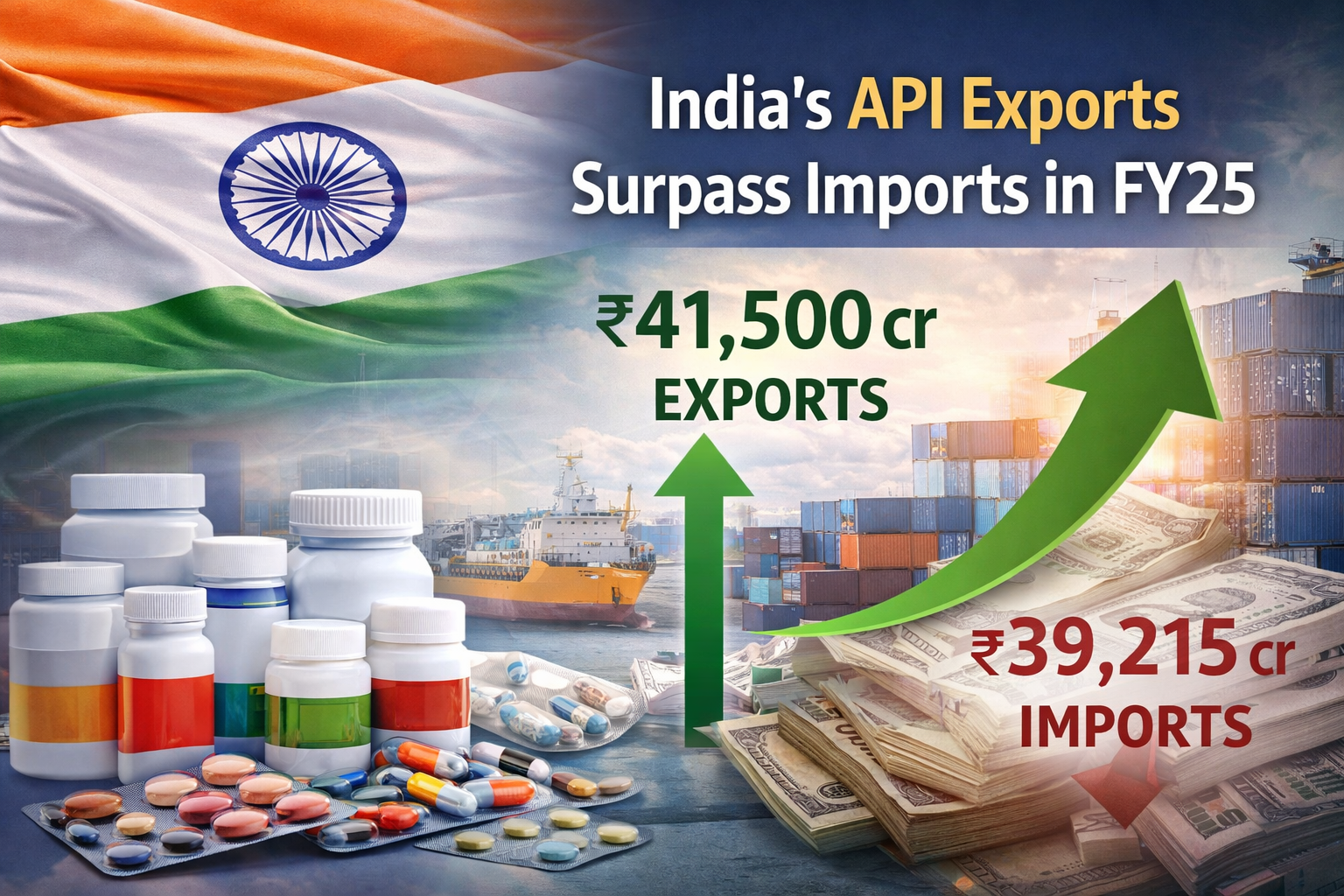
India’s pharmaceutical sector has achieved a significant milestone in FY25, with exports of Active Pharmaceutical Ingredients (APIs) surpassing imports. This development marks a crucial step toward strengthening the country’s position as a global pharmaceutical hub while reducing dependency on foreign markets. With exports reaching approximately ₹41,500 crore and imports standing at around ₹39,215 crore, the shift reflects growing domestic manufacturing capabilities and strategic policy support.
This achievement not only highlights India’s progress in the pharmaceutical supply chain but also reinforces its vision of becoming a self-reliant economy in the healthcare sector.
What Are APIs and Why They Matter
Active Pharmaceutical Ingredients (APIs), also known as bulk drugs, are the core components used in the manufacturing of medicines. They play a vital role in determining the effectiveness of a drug. Without APIs, the production of finished pharmaceutical formulations is not possible.
India has traditionally been a major supplier of generic medicines worldwide, but it has relied heavily on imports—especially for APIs. This dependency has often exposed the industry to supply chain risks and price fluctuations. Therefore, increasing domestic API production has been a long-standing priority for policymakers and industry stakeholders.
Key Highlights of India’s API Trade in FY25
The latest data indicates a positive shift in India’s API trade balance:
-
API Exports: ~₹41,500 crore
-
API Imports: ~₹39,215 crore
-
Export Surplus: India exported more APIs than it imported
This marks a turning point for the pharmaceutical industry, as it demonstrates improved manufacturing strength and reduced reliance on imports.
Over the past few years, imports have steadily increased—from ₹36,229 crore in 2022-23 to ₹39,215 crore in FY25. However, the faster growth in exports has helped India achieve a favorable balance.
Dependence on Imports and the China Factor
Despite the positive export trend, India still relies significantly on imports for certain critical APIs and intermediates. A large portion of these imports comes from China, which continues to dominate the global API supply chain.
The share of imports from China has increased over recent years, highlighting the need for further diversification and domestic capacity building. Heavy reliance on a single country poses risks such as supply disruptions, geopolitical tensions, and price volatility.
This is why reducing import dependence remains a strategic priority for the Indian pharmaceutical sector.
Government Initiatives Driving Growth
The government has introduced several initiatives over the past decade to strengthen domestic API production. One of the most impactful measures is the Production Linked Incentive (PLI) scheme for bulk drugs.
Key Objectives of the PLI Scheme:
-
Promote domestic manufacturing of APIs and intermediates
-
Reduce dependency on imports
-
Strengthen supply chain resilience
-
Encourage investment in pharma infrastructure
With an outlay of ₹6,940 crore, the scheme has already delivered promising results. It has helped establish domestic manufacturing capacity of approximately 56,800 tonnes per annum for several critical products.
Impact of the PLI Scheme on the Pharma Sector
The PLI scheme has significantly contributed to boosting local production and reducing import reliance. Some of the notable outcomes include:
-
Increased Domestic Production: Expansion of API manufacturing units across India
-
Import Substitution: Reduction in dependency on foreign suppliers
-
Export Growth: Strengthening India’s position in global markets
-
Job Creation: Thousands of employment opportunities generated
By December 2025, the scheme had resulted in cumulative sales of over ₹2,700 crore, including exports worth more than ₹500 crore. Additionally, it has helped avoid imports worth over ₹2,100 crore.
These figures clearly indicate that policy-driven growth is playing a crucial role in reshaping the pharmaceutical landscape.
Strengthening Self-Reliance in Pharma
India’s success in surpassing API imports with exports is a major step toward achieving self-reliance in the pharmaceutical sector. However, there is still a long way to go.
To build a fully resilient ecosystem, the industry must focus on:
-
Expanding production of critical APIs
-
Investing in advanced manufacturing technologies
-
Reducing cost inefficiencies
-
Diversifying import sources
-
Enhancing research and development
Self-reliance does not mean eliminating imports entirely but creating a balanced ecosystem where domestic production can meet a significant portion of demand.
Opportunities for Pharma Businesses
The growing focus on API manufacturing presents significant opportunities for entrepreneurs, manufacturers, and investors. As demand for locally produced APIs increases, businesses can benefit from:
-
Government incentives and subsidies
-
Rising global demand for quality medicines
-
Expansion of export markets
-
Increased profitability in bulk drug manufacturing
This is an ideal time for stakeholders to explore opportunities in API production and strengthen their presence in the pharmaceutical value chain.
Future Outlook of India’s API Industry
The future of India’s API industry looks promising, driven by strong policy support, increasing investments, and global demand for affordable medicines. As supply chains evolve, India is well-positioned to become a reliable alternative to traditional API suppliers.
However, sustained growth will depend on continuous innovation, infrastructure development, and strategic collaborations between government and industry players.
With the right approach, India can not only maintain its export surplus but also emerge as a global leader in API manufacturing.
Conclusion
India’s achievement of exporting more APIs than it imports in FY25 is a significant milestone for the pharmaceutical industry. It reflects the success of government initiatives, the resilience of domestic manufacturers, and the country’s growing capabilities in bulk drug production.
While challenges such as import dependency and global competition remain, the progress made so far is encouraging. By continuing to invest in domestic manufacturing and policy support, India is steadily moving toward a self-reliant and globally competitive pharmaceutical ecosystem.