
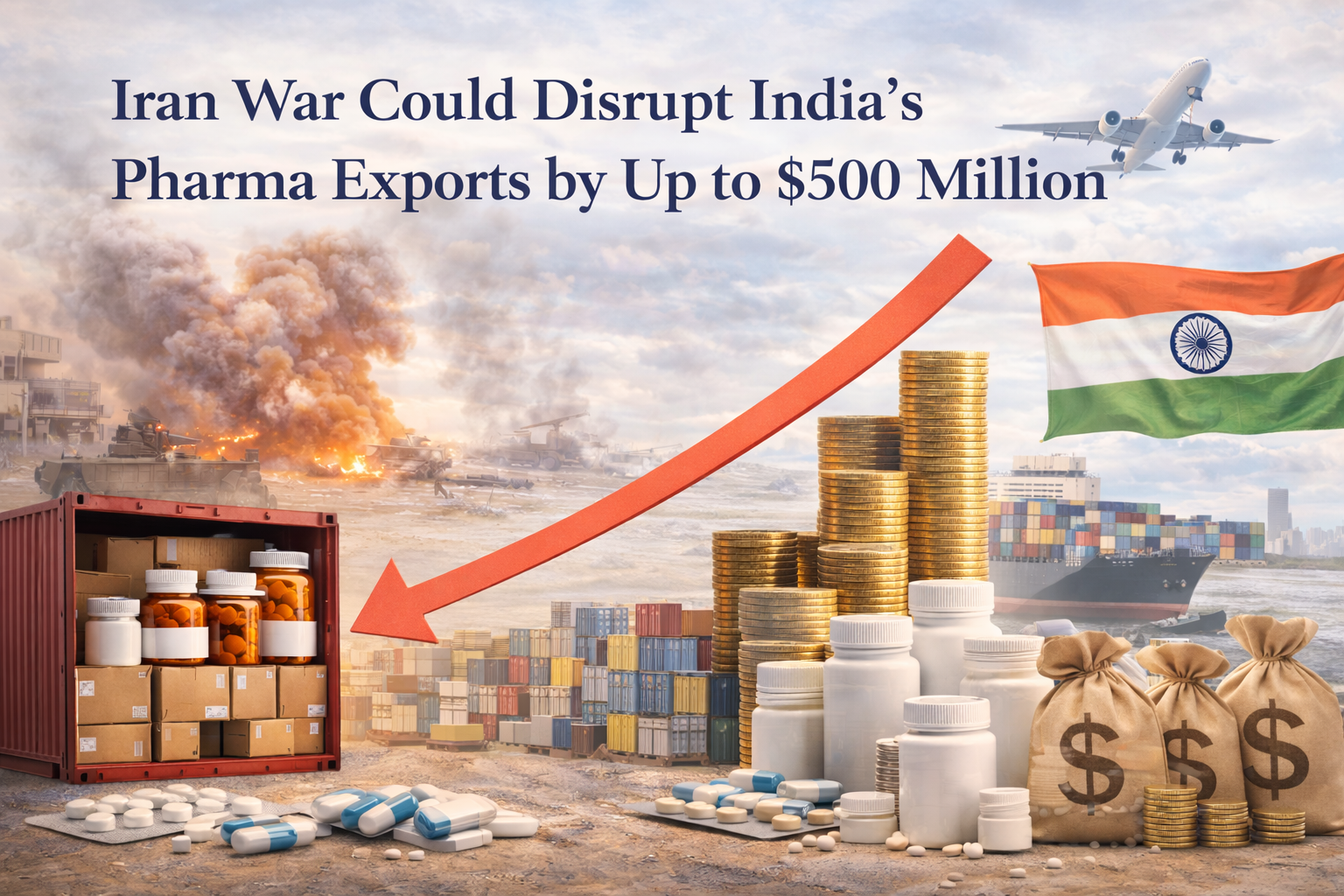
India’s pharmaceutical export industry, one of the largest suppliers of affordable medicines globally, is facing potential disruption due to the ongoing conflict involving Iran and rising geopolitical tensions in the Middle East. Industry experts estimate that India’s pharma exports could face a loss of $300–$500 million if the current situation continues for a prolonged period.
The major challenge is not manufacturing capacity but logistics disruptions, rising freight costs, and shipping restrictions, which are complicating the movement of pharmaceutical products and raw materials.
Rising Freight Costs Impact Global Supply Chains
One of the most immediate impacts of the Iran conflict is the sharp rise in freight costs. Shipping companies are either increasing charges or refusing cargo destined for Gulf region hubs due to security concerns.
Industry estimates indicate that freight charges for bulk drugs imported from China have doubled, increasing from around $1,200 to $2,400 per container. Additionally, some shipping lines are imposing extra surcharges ranging from $3,500 to $5,000 for shipments heading toward Middle Eastern ports.
These sudden cost increases are affecting both pharmaceutical exporters and manufacturers who rely on international supply chains.
Importance of the Middle East for Indian Pharma Exports
The Middle East and Gulf Cooperation Council (GCC) countries play an important role in India’s pharmaceutical trade network. Currently, this region accounts for approximately 5–6% of India’s total drug exports, which exceed $30 billion annually.
Apart from being a major destination market, the Middle East also acts as a key transit hub for shipments heading toward Europe and the United States. Any disruption in shipping routes through this region can therefore impact multiple global supply chains simultaneously.
If the conflict continues and shipping restrictions persist, pharmaceutical exporters may face delays and increased operational costs.
Dual Pressure on Raw Materials and Finished Medicines
The pharmaceutical sector is experiencing a two-sided impact from rising logistics challenges.
Raw Material Imports
India imports a significant portion of Active Pharmaceutical Ingredients (APIs), intermediates, and raw materials from China and other international markets. Rising freight costs are increasing production expenses for pharmaceutical manufacturers.
Export of Finished Medicines
Once medicines are manufactured in India, they must be shipped to global markets. However, shipping companies are now reluctant to accept cargo destined for certain Gulf ports, making export logistics more complicated.
This dual pressure is creating operational challenges for pharmaceutical companies trying to maintain supply continuity.
Airspace Closures and Transportation Challenges
Another major concern for exporters is the closure of certain air routes across the Middle East. Pharmaceutical companies often rely on air freight to transport urgent or temperature-sensitive medicines.
Air cargo is particularly important when there is a sudden shortage of medicines in global markets. In such situations, companies can quickly ship products and benefit from higher prices.
However, with airspace restrictions and increasing air freight costs, companies may struggle to respond quickly to urgent international demand.
Inventory Strategies to Avoid Supply Disruptions
To manage these uncertainties, many pharmaceutical companies have increased their inventory buffers.
Previously, companies typically maintained two-and-a-half to three months of inventory in global markets. Today, many firms are holding three to three-and-a-half months of stock, including goods already in transit.
Maintaining higher inventory levels allows companies to continue supplying medicines even when transportation routes face disruptions.
Industry experts believe this strategy will help prevent immediate shortages in global markets.
Risk to Temperature-Sensitive Shipments
Temperature-controlled pharmaceutical products require strict cold-chain logistics to maintain quality and safety. If shipments are delayed due to airspace closures or shipping restrictions, medicines could remain stuck for several days.
Such delays can create serious risks for temperature-sensitive drugs and raw materials, potentially affecting their quality and shelf life.
This is another reason why pharmaceutical companies are closely monitoring logistics conditions and planning alternative routes where possible.
Impact on Manufacturing Inputs
The conflict may also influence the cost of certain chemical inputs used in pharmaceutical production.
For example, methanol, a solvent used in API manufacturing, is often sourced from Middle Eastern countries such as Saudi Arabia. If tanker traffic through key maritime routes such as the Strait of Hormuz is disrupted, petrochemical prices could rise significantly.
Higher prices for solvents, packaging materials, and chemical intermediates could indirectly increase pharmaceutical production costs.
Strengthening Manufacturing and Distribution Systems
To remain competitive despite global uncertainties, many pharmaceutical companies are focusing on strengthening production and supply chain efficiency.
Collaborating with a reliable pharma contract manufacturing company helps businesses expand production capacity while maintaining strict quality standards.
Contract manufacturing enables pharmaceutical companies to:
-
Increase manufacturing output quickly
-
Reduce operational costs
-
Ensure compliance with regulatory standards
-
Improve supply chain flexibility
This approach is becoming increasingly important as global demand for medicines continues to grow.
Role of Regional Distribution Networks
Another strategy used by pharmaceutical companies is expanding regional distribution partnerships. Many businesses work with distributors operating under the monopoly medicine company in india model.
Under this system, distributors receive exclusive rights to market and sell products within specific territories. This structure helps ensure efficient product availability and stronger relationships with local partners.
Such distribution networks allow pharmaceutical companies to maintain supply continuity even during global logistical disruptions.
Temporary Disruption, Not a Long-Term Crisis
Industry analysts believe that while the Iran conflict may create short-term supply challenges, it is unlikely to cause a long-term crisis for India’s pharmaceutical sector.
India has demonstrated resilience in the past, including during the COVID-19 pandemic, when it maintained consistent global medicine supplies despite severe logistical disruptions.
Most pharmaceutical companies currently have three to six months of drug inventory available, which should help prevent immediate shortages.
Conclusion
The ongoing Iran conflict has introduced uncertainty into global pharmaceutical logistics, with rising freight costs and shipping disruptions posing challenges for exporters. If the situation persists, India’s pharmaceutical exports could face temporary losses of $300–$500 million.
However, strong manufacturing capacity, strategic inventory planning, and efficient supply chain management are helping companies navigate the situation. With proactive planning and continued global demand for affordable medicines, India’s pharmaceutical industry remains well positioned to overcome these temporary disruptions and continue its growth in the global healthcare market.