
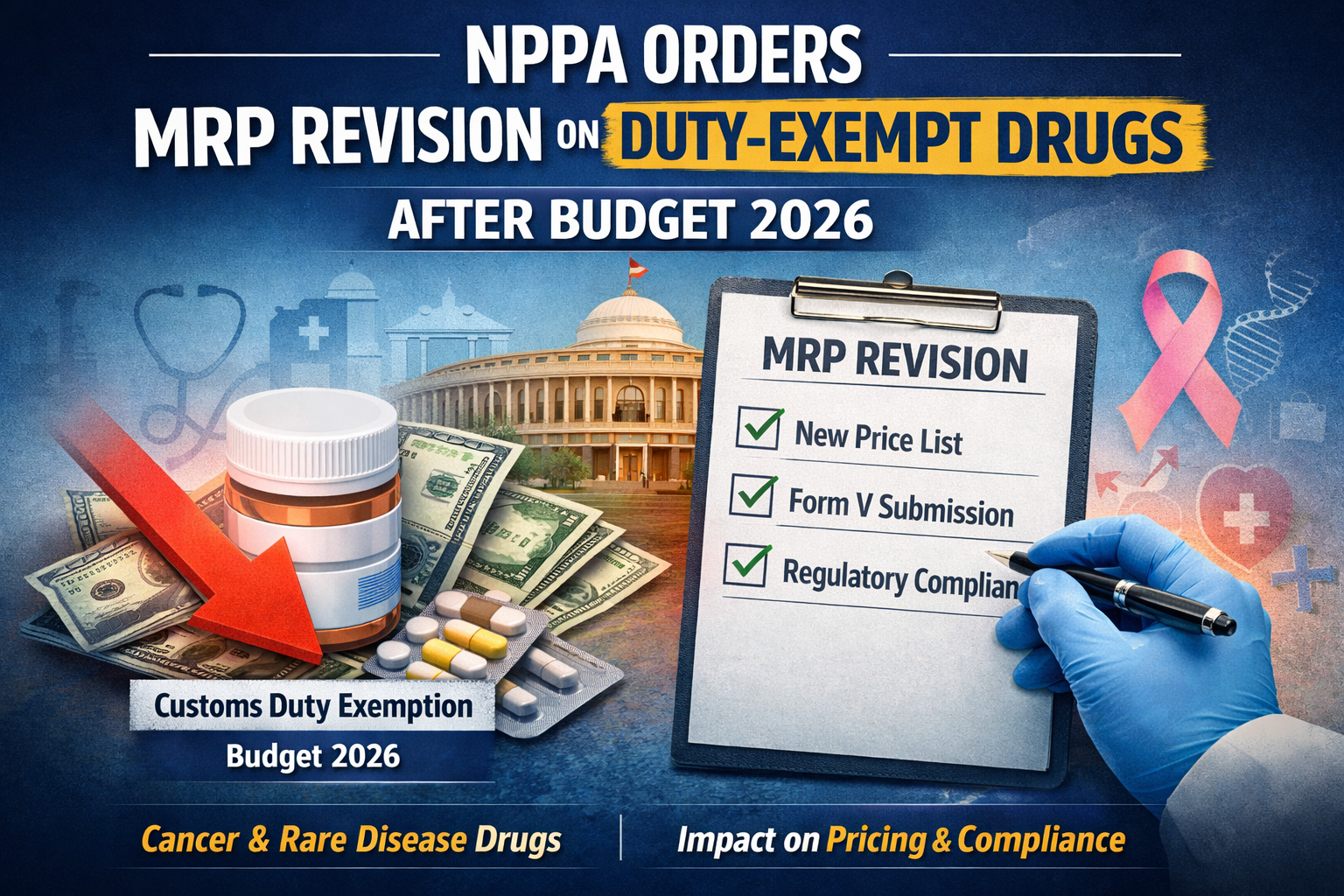
In a significant post-budget development, the National Pharmaceutical Pricing Authority (NPPA) has directed pharmaceutical manufacturers and marketing companies to revise the Maximum Retail Price (MRP) of drugs that have been granted customs duty exemptions in the Union Budget 2026–27.
The move is aimed at ensuring that the fiscal benefits announced by the government are passed on directly to patients and do not remain confined to supply-chain margins.
NPPA’s Directive: Mandatory MRP Revision
In an official memorandum, the price regulator instructed that:
All manufacturers and marketing companies selling drugs/formulations that have received customs duty exemption from the Department of Revenue are required to revise their MRP accordingly.
The authority further mandated:
-
Submission of revised pricing information through Form V.
-
Issuance of an updated price list or supplementary price list.
-
Communication of the revised MRP to:
-
Dealers
-
State Drug Controllers
-
The Government
-
This directive reinforces the regulator’s commitment to price transparency and consumer protection in India’s pharmaceutical market.
Budget 2026: What Changed?
In the Union Budget for FY 2026–27, the Finance Minister announced:
-
Exemption of basic customs duty on 17 life-saving cancer drugs
-
Addition of seven rare diseases under the customs duty exemption framework
-
Zero import duty on personal imports of:
-
Drugs and medicines
-
Food for Special Medical Purposes (FSMP) used in rare disease treatment
-
Existing Duty Structure (Before Exemption)
-
Standard drugs: 10% basic customs duty
-
Selected life-saving drugs and vaccines: 5% concessional duty
The latest exemption reduces the import duty burden to 0% for specified categories, theoretically lowering procurement costs.
Why MRP Revision Is Critical
Customs duty exemptions reduce the landed cost of imported drugs. However, without regulatory intervention, the cost savings may not automatically translate into lower retail prices.
By mandating MRP revision:
-
The NPPA ensures compliance with the Drugs (Prices Control) Order (DPCO) framework.
-
It curbs potential profiteering.
-
It protects patients from artificial price inflation.
This regulatory action is especially important in high-cost therapeutic areas like oncology and rare diseases, where treatment expenses can run into lakhs per month.
Will Patients See Real Relief?
While the policy intent is clear, healthcare experts and patient advocates have pointed out that:
-
Customs duty forms only a small percentage of the total therapy cost.
-
The bulk of pricing is influenced by:
-
Research & development costs
-
Import logistics
-
Marketing margins
-
Distribution mark-ups
-
Hospital procurement structures
-
As a result, the overall reduction in MRP may be modest in certain cases.
However, even incremental reductions are significant in chronic or long-term therapies where cumulative costs are substantial.
Allegations of Profiteering: Industry Under Watch
Some patient advocacy groups have alleged that previous tax concessions and duty relaxations were not fully passed on to consumers.
There have been concerns that:
-
Marketers retained pricing advantages.
-
End-user prices remained unchanged despite cost reductions.
-
Information asymmetry prevented patients from verifying genuine price adjustments.
The NPPA’s strict documentation requirement—especially mandatory filing through Form V—acts as a compliance mechanism to prevent such practices.
Compliance Requirements for Pharma Companies
Manufacturers and marketing firms must:
-
Recalculate MRP in proportion to customs duty benefit.
-
Submit updated pricing data via statutory format.
-
Circulate revised price lists across the distribution chain.
-
Maintain transparency with regulatory authorities.
Non-compliance may attract penalties under applicable price control regulations.
Broader Impact on the Indian Pharma Market
India’s pharmaceutical sector operates under a dual system:
-
Price-controlled drugs under DPCO
-
Non-scheduled drugs with market-driven pricing
The latest directive strengthens regulatory oversight in the non-scheduled segment, particularly for imported and high-value drugs.
For companies operating in structured distribution models, including those aligned with the framework of a
monopoly medicine company in india, transparent pricing and regulatory compliance will become increasingly important for sustainable growth.
As the government tightens post-budget compliance checks, businesses will need to:
-
Reassess cost structures.
-
Strengthen documentation processes.
-
Ensure audit-ready pricing records.
-
Maintain ethical pricing standards.
Rare Diseases: A Policy Shift Toward Inclusion
The addition of seven rare diseases to the customs exemption list signals a progressive policy approach. Rare disease treatments are often imported and extremely high-priced.
Zero-duty imports for:
-
Life-saving drugs
-
Specialty medicines
-
FSMP products
can reduce financial stress on families dealing with lifelong conditions.
However, effective implementation will depend on:
-
Transparent pricing revisions
-
Hospital-level compliance
-
Supply-chain accountability
What This Means Going Forward
The NPPA’s direction is not merely procedural—it is a structural intervention to ensure that fiscal benefits announced in the Budget translate into tangible patient relief.
Key takeaways:
-
Customs duty exemptions must result in lower MRP.
-
Manufacturers must formally notify revised prices.
-
Regulatory oversight is intensifying.
-
Patients and advocacy groups are closely monitoring outcomes.
The coming months will determine how effectively the industry aligns with this directive and whether the intended price relief becomes visible at the pharmacy counter.
Conclusion
The NPPA’s instruction to revise MRP following customs duty exemptions in Budget 2026 represents a decisive regulatory step toward consumer-centric pricing. While the actual price reduction may vary depending on cost composition, the mandate reinforces transparency, compliance, and accountability in India’s pharmaceutical ecosystem.
As healthcare affordability remains a national priority, coordinated action between policymakers, regulators, manufacturers, and distributors will be essential to ensure that tax benefits truly reach the patients who need them most.