
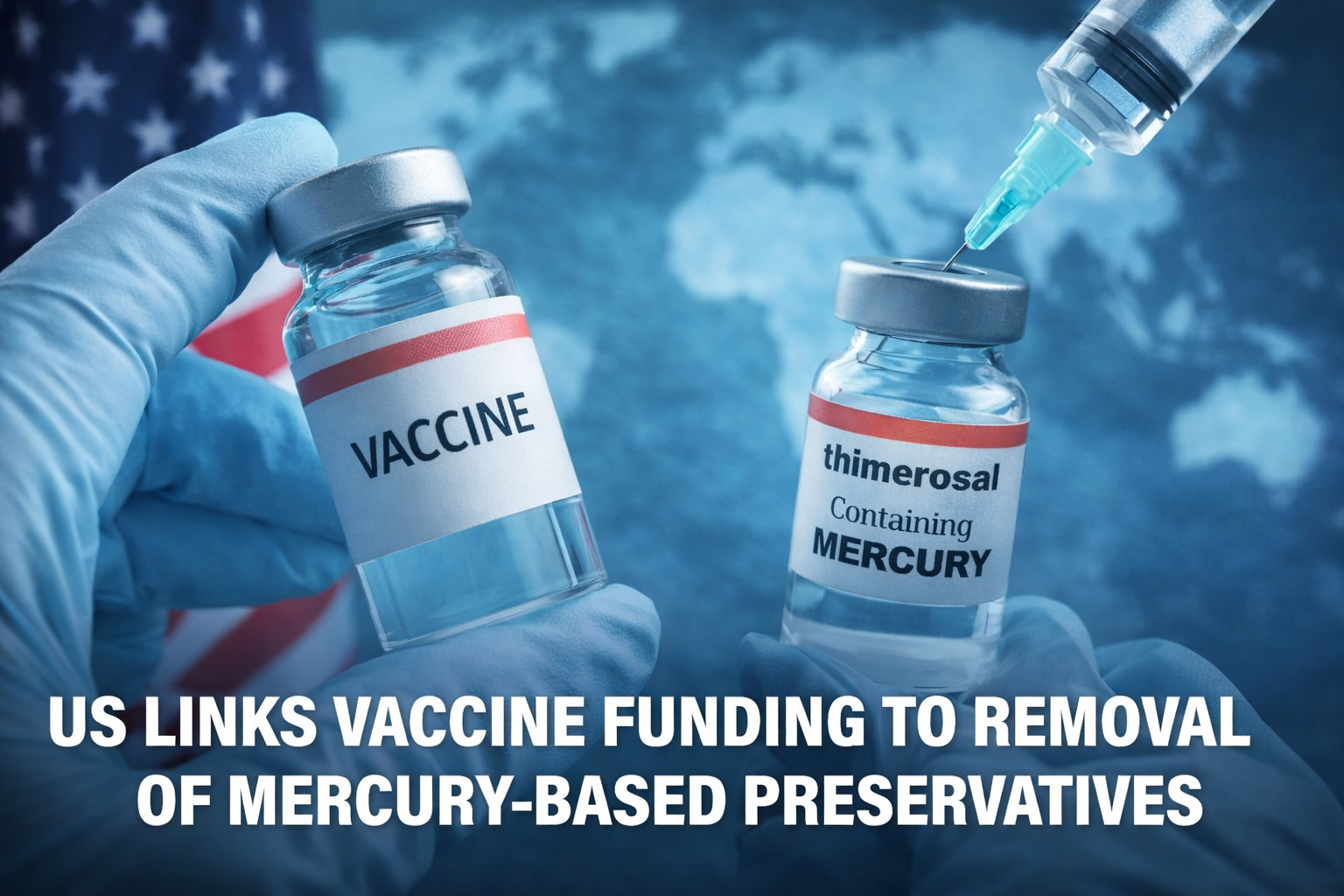
Global immunisation efforts are facing renewed scrutiny as funding conditions increasingly influence public health policy. A recent development highlights how financial support for international vaccination programs is being tied to the removal of mercury-based preservatives from vaccines. This move has reopened long-standing debates around vaccine safety, scientific evidence, and equitable access to immunisation in low- and middle-income countries.
This article explores the funding conditions, the science behind mercury-based preservatives, and the potential global impact on vaccination programs.
What Are Mercury-Based Preservatives in Vaccines?
Mercury-based preservatives, commonly used in vaccines for decades, serve a specific and critical purpose. They help prevent bacterial and fungal contamination, particularly in multi-dose vaccine vials. These vials are widely used in large-scale immunisation programs because they:
-
Reduce manufacturing and transportation costs
-
Simplify storage and distribution
-
Enable rapid vaccination in resource-limited settings
The preservative contains a form of mercury that has been extensively studied and differs chemically from environmental mercury exposure.
Why Is Funding Being Conditioned?
The United States has reportedly informed a global vaccine funding body that future financial contributions will depend on a plan to phase out vaccines containing mercury-based preservatives. Until such a plan is developed and initiated, new funding may be withheld.
This decision reflects broader efforts to align international immunisation policies with standards followed in many high-income countries, where single-dose vaccine formats are more common and preservatives are less frequently used.
The Role of Anti-Vaccine Claims
For decades, certain advocacy groups have claimed a link between mercury-based preservatives and neurodevelopmental disorders, including autism. These claims originated in the 1990s and continue to circulate widely online and on social media.
However, multiple large-scale scientific studies conducted over several decades have found no credible evidence supporting these claims. Health experts consistently state that the risks associated with vaccine-preventable diseases far outweigh any theoretical concerns related to preservatives.
Scientific Consensus on Safety
The safety of mercury-based preservatives has been one of the most extensively studied topics in vaccine research. According to global health authorities and independent researchers:
-
No causal link has been established between these preservatives and developmental disorders
-
Exposure levels in vaccines are far below harmful thresholds
-
Removing preservatives does not significantly improve safety outcomes
Scientific consensus continues to support the use of these preservatives, particularly when they enable broader vaccine access.
Impact on Low- and Middle-Income Countries
One of the most significant concerns surrounding this funding condition is its potential effect on countries with limited healthcare infrastructure.
Challenges These Countries May Face:
-
Higher costs if forced to shift to single-dose vials
-
Increased logistical complexity in storage and transportation
-
Reduced vaccination coverage due to budget constraints
Multi-dose vaccines play a vital role in mass immunisation campaigns against diseases such as measles, diphtheria, and hepatitis. Any disruption could leave millions of children unprotected.
Funding Gaps and Cost-Cutting Measures
The global vaccine funding system already faces financial pressure due to reduced contributions from several high-income nations. The possible withholding of additional funds may deepen these gaps, forcing international immunisation programs to adopt cost-cutting strategies.
Such measures could include:
-
Delayed vaccine rollouts
-
Reduced support for routine immunisation
-
Increased dependence on bilateral agreements
These changes may disproportionately affect the most vulnerable populations.
Global Health Policy Implications
This development underscores how political priorities and funding strategies can shape global health policy, sometimes independently of scientific consensus. While governments have the right to set funding conditions, experts warn that public health decisions should remain evidence-based.
Balancing national policy preferences with global health needs remains a complex challenge, particularly in an interconnected world where disease outbreaks do not respect borders.
Conclusion
Linking vaccine funding to the removal of mercury-based preservatives has reignited a long-standing debate at the intersection of science, politics, and public health. While concerns about safety continue to be raised by some groups, decades of research support the continued use of these preservatives, especially where they enable affordable and widespread immunisation.
As global vaccination efforts evolve, policymakers face a critical responsibility: ensuring that funding decisions do not undermine access to life-saving vaccines for the world’s most at-risk populations.