
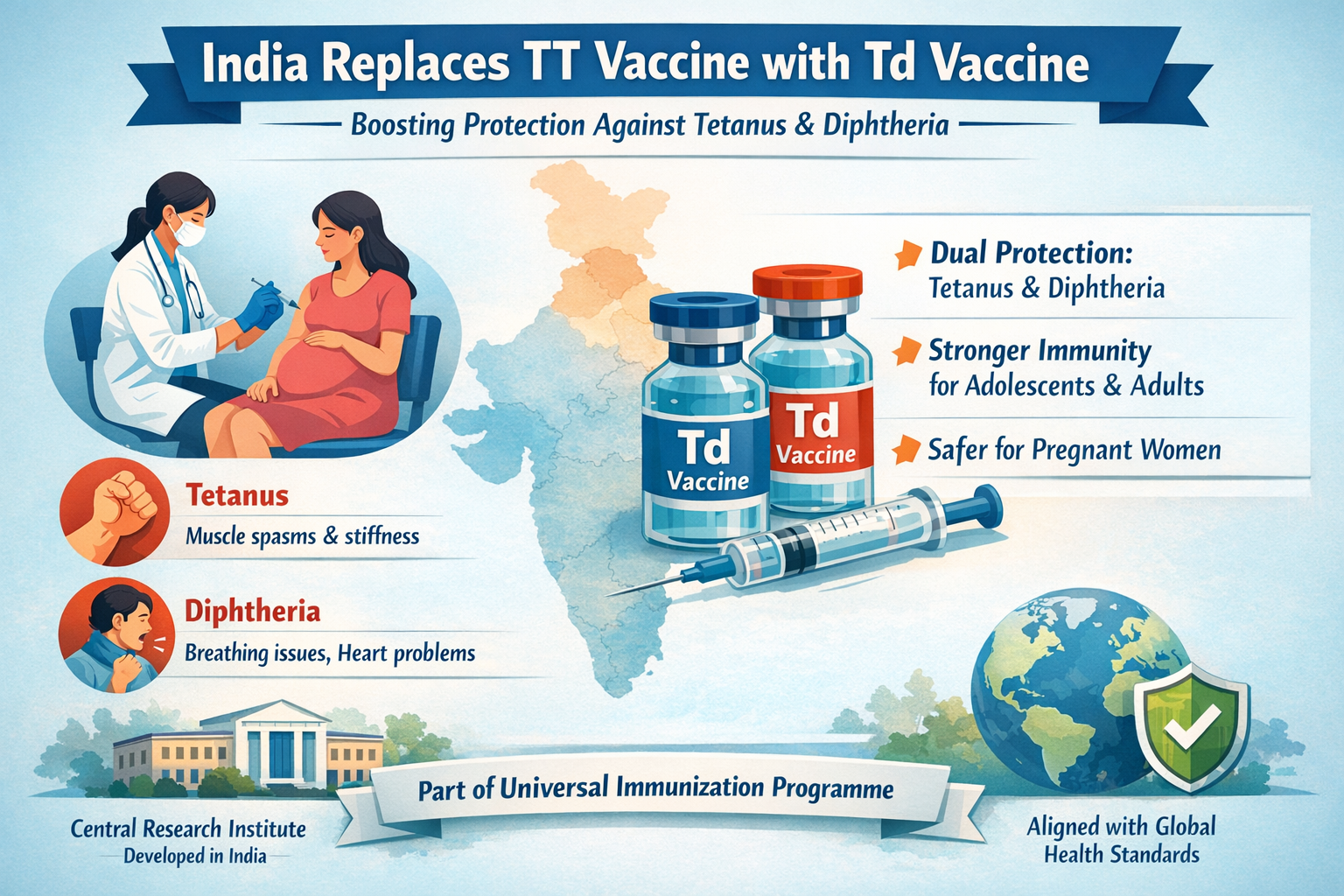
India’s public health system is entering a new phase with the replacement of the long-used Tetanus Toxoid (TT) vaccine by the broader Tetanus and adult Diphtheria (Td) vaccine. The official launch at the Central Research Institute marks a strategic shift in the country’s immunisation policy.
This transition strengthens protection not only against tetanus but also against diphtheria — a serious and potentially life-threatening infection. The move aligns India’s vaccination programme with international public health recommendations and reflects an evidence-based approach to long-term disease prevention.
Why India Is Replacing the TT Vaccine
For decades, the TT vaccine has played a critical role in preventing tetanus, especially among pregnant women and adults requiring booster doses. However, evolving epidemiological data and global guidance have prompted health authorities to upgrade to the Td vaccine.
The Td vaccine provides dual protection:
-
Tetanus, a bacterial infection causing severe muscle stiffness and spasms
-
Diphtheria, a contagious respiratory disease that can lead to breathing difficulty, heart failure, nerve damage, and paralysis
While childhood immunisation using DPT vaccines significantly reduced both diseases, immunity against diphtheria tends to decline over time. Without booster doses, adolescents and adults may become vulnerable again.
Alignment with Global Immunisation Guidelines
The shift from TT to Td follows long-standing recommendations from the World Health Organization. As early as 2006, global health experts advised countries to replace TT with Td in national immunisation schedules to ensure continued diphtheria immunity alongside tetanus protection.
India’s advisory body, the National Technical Advisory Group on Immunization, later endorsed this recommendation. The guidance included replacing TT with Td for:
-
Adolescents
-
Adults
-
Pregnant women
This decision ensures sustained elimination of maternal and neonatal tetanus while also reinforcing diphtheria immunity in older age groups.
Understanding Tetanus and Diphtheria Risks
1. Tetanus
Tetanus is caused by bacteria found in soil, dust, and animal waste. It enters the body through wounds or cuts. The infection leads to painful muscle contractions, commonly starting in the jaw (often called “lockjaw”), and can be fatal if untreated.
Despite major reductions in cases due to vaccination campaigns, tetanus remains a medical emergency when it occurs.
2. Diphtheria
Diphtheria spreads through respiratory droplets. It primarily affects the throat and nose and can form a thick grey membrane that obstructs breathing. Severe complications may include:
-
Myocarditis (heart inflammation)
-
Nerve damage
-
Respiratory failure
Although largely controlled, sporadic outbreaks highlight the importance of maintaining immunity across all age groups.
What Makes the Td Vaccine Different?
The Td vaccine contains purified toxoids for both tetanus and diphtheria. It is formulated specifically for adolescents and adults, providing booster-level immunity rather than primary immunisation.
Key benefits include:
-
Broader disease coverage
-
Stronger long-term community immunity
-
Reduced risk of adult diphtheria outbreaks
-
Continued maternal and neonatal tetanus protection
By combining protection against two serious diseases, Td improves cost-effectiveness and strengthens overall public health resilience.
Role of the Central Research Institute
The Td vaccine being introduced into the Universal Immunization Programme has been developed and manufactured by the Central Research Institute, operating under the Directorate General of Health Services.
The institute completed:
-
Developmental and clinical evaluation studies
-
Regulatory approvals
-
Quality validation by the Central Drugs Laboratory
-
Commercial-scale production
Following the national launch, approximately 55 lakh doses are expected to be supplied to the Universal Immunization Programme by April 2026. Production capacity is projected to expand in subsequent phases to ensure uninterrupted supply.
Impact on India’s Universal Immunization Programme
India’s Universal Immunization Programme (UIP) is one of the largest public health initiatives globally. The introduction of Td strengthens the UIP by:
-
Modernising the immunisation schedule
-
Reducing disease burden among adolescents and adults
-
Supporting maternal health objectives
-
Maintaining elimination of neonatal tetanus
The change reflects a proactive approach — not merely responding to outbreaks but preventing them through anticipatory vaccination policy.
Public Health Significance of the Transition
Replacing TT with Td is not simply a product substitution. It represents:
-
Policy evolution based on scientific evidence
-
Harmonisation with global standards
-
Strengthening of herd immunity
-
Enhanced adult vaccination focus
In recent years, experts have emphasised the importance of adult immunisation as immunity from childhood vaccines can diminish. Introducing Td ensures that protection does not weaken over time.
What This Means for Pregnant Women
Pregnant women have traditionally received TT shots to prevent maternal and neonatal tetanus. Under the new policy, Td will replace TT in antenatal care schedules.
This ensures:
-
Continued protection against tetanus
-
Added protection against diphtheria
-
Improved maternal and newborn safety
Maintaining high coverage rates will remain critical to sustaining India’s maternal and neonatal health achievements.
Strengthening India’s Preventive Healthcare Framework
The introduction of Td vaccine signals a broader shift toward preventive healthcare reinforcement. With evolving disease patterns and global mobility, strengthening immunisation beyond childhood is essential.
Key outcomes expected include:
-
Reduced risk of adult diphtheria resurgence
-
Long-term disease elimination sustainability
-
Improved public health preparedness
-
Enhanced vaccine manufacturing self-reliance
By expanding protection scope and aligning with international immunisation best practices, India is reinforcing its commitment to safeguarding population health.
Conclusion
India’s decision to replace the TT vaccine with the Td vaccine is a strategic public health milestone. By expanding protection to include diphtheria alongside tetanus, the country is strengthening immunity across all age groups.
With manufacturing led by the Central Research Institute and rollout under the Universal Immunization Programme, the shift ensures broader disease prevention, sustained maternal and neonatal protection, and alignment with global vaccination standards.
As immunisation science evolves, policy updates like this play a crucial role in maintaining disease control and protecting future generations through evidence-based preventive healthcare strategies.