
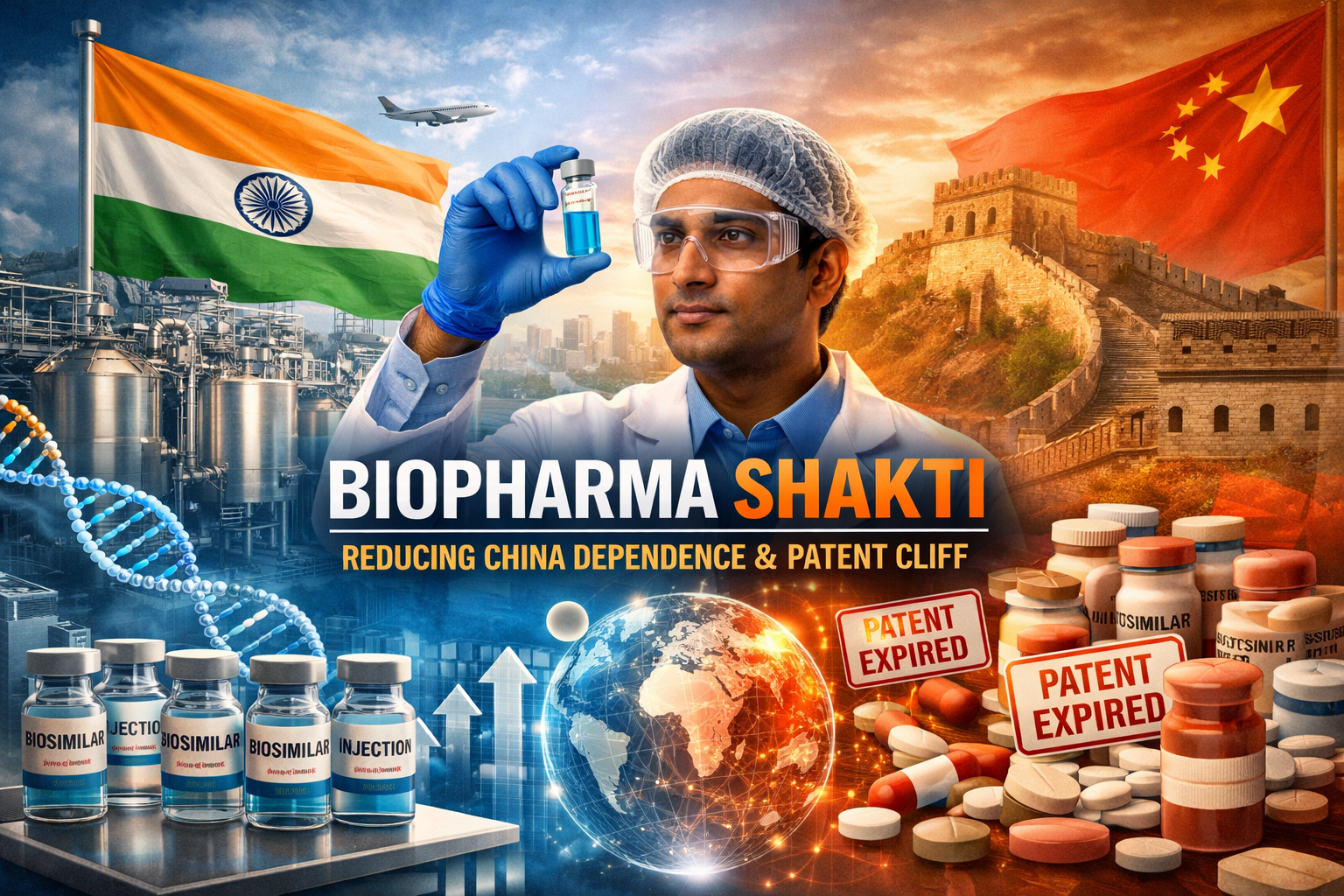
India’s pharmaceutical landscape is entering a decisive transformation phase with the launch of Biopharma Manufacturing Shakti, announced in Budget 2026. Backed by an outlay of ₹10,000 crore, this initiative is not just another industrial incentive—it is a strategic intervention designed to reshape India’s position in the global biopharmaceutical value chain. At its core, the program addresses two pressing realities: reducing dependence on China for critical bio-inputs and leveraging the upcoming global patent cliff of blockbuster biologic drugs.
Why Biopharma Manufacturing Matters Now
Biopharmaceuticals—including biologics, biosimilars, vaccines, and advanced therapies—are among the fastest-growing segments of global healthcare. However, despite India’s dominance in generic medicines, the country still relies heavily on imports for key raw materials, intermediates, and advanced bio-components, many of which come from China. The Covid-19 pandemic exposed the risks of such dependence, disrupting supply chains and highlighting vulnerabilities in critical healthcare sectors.
Biopharma Manufacturing Shakti aims to correct this imbalance by building domestic capabilities across the entire biopharma ecosystem—from upstream research to large-scale commercial manufacturing.
Strategic Goal 1: Reducing China Dependence
One of the central objectives of the initiative is supply chain security. Biopharmaceutical manufacturing is complex, capital-intensive, and technologically demanding. For years, India has depended on external suppliers for fermentation inputs, cell lines, growth media, and other critical materials. This dependence poses both economic and geopolitical risks.
Through targeted incentives, infrastructure support, and policy alignment, the government intends to encourage domestic production of these components. Strengthening indigenous capabilities will not only reduce import dependency but also improve cost stability, quality control, and regulatory resilience for Indian manufacturers.
This shift also opens opportunities for specialized players operating as a pharma contract manufacturing company, enabling smaller innovators and global firms to manufacture advanced biologics within India without setting up greenfield facilities.
Strategic Goal 2: Capitalizing on the Global Patent Cliff
The second pillar of Biopharma Shakti focuses on the impending patent expirations of several high-revenue biologic drugs, traditionally dominated by companies in the Global North. Over the next decade, multiple blockbuster biologics used in oncology, immunology, and chronic diseases are set to lose patent protection.
This creates a massive opening for biosimilars—cost-effective alternatives that require advanced manufacturing and regulatory expertise. India’s proven strength in generics, combined with growing biologics capabilities, positions it well to become a global biosimilar hub.
By supporting R&D, clinical development, and scalable manufacturing, the initiative enables Indian companies to move beyond volume-driven generics into high-value, innovation-led segments.
Strengthening India’s Global Pharma Standing
Biopharma Manufacturing Shakti is also a strategic move to enhance India’s global credibility as a reliable pharmaceutical supplier. As countries worldwide seek to diversify supply chains away from single-country dependence, India can emerge as a trusted alternative.
This evolution supports the rise of niche, high-value production models, including segments where companies can operate with exclusive portfolios—similar to a monopoly medicine company in India—by focusing on specialized biologics, rare disease therapies, or region-specific biosimilars.
Policy Support and Ecosystem Development
Beyond funding, the success of Biopharma Manufacturing Shakti depends on ecosystem-wide coordination. This includes:
-
Development of biopharma parks and shared infrastructure
-
Faster regulatory pathways aligned with global standards
-
Skilled workforce development in biotechnology and biologics manufacturing
-
Public–private collaboration for translational research
Such measures ensure that innovation moves seamlessly from lab to market, reducing time-to-commercialization and improving global competitiveness.
Learning from the Covid-Era Experience
The pandemic fundamentally changed how nations view healthcare security. Vaccines, biologics, and advanced therapies are now seen as strategic assets, not just commercial products. India’s experience during Covid—both as a vaccine producer and as a country facing supply bottlenecks—has directly influenced the design of Biopharma Manufacturing Shakti.
The initiative reflects a long-term vision: building resilience, technological depth, and strategic autonomy in healthcare manufacturing.
Implications for the Indian Pharmaceutical Industry
For the Indian pharma sector, this initiative signals a shift from scale-driven growth to capability-driven leadership. Companies are encouraged to invest in:
-
Advanced biologics and biosimilars
-
Complex manufacturing technologies
-
Global regulatory compliance
-
Long-term innovation pipelines
Contract manufacturing, technology transfer partnerships, and global collaborations are expected to accelerate, further integrating India into international biopharma supply networks.
Conclusion
Biopharma Manufacturing Shakti represents a bold and timely step in India’s pharmaceutical journey. By targeting China dependence and positioning the country to benefit from the global patent cliff, the initiative lays the foundation for India to become a major force in biopharmaceutical manufacturing. As supply chains realign and demand for affordable biologics rises worldwide, India’s strategic focus on biosimilars, emerging biologics, and advanced manufacturing could redefine its role—from the pharmacy of the world to a global biopharma powerhouse.