
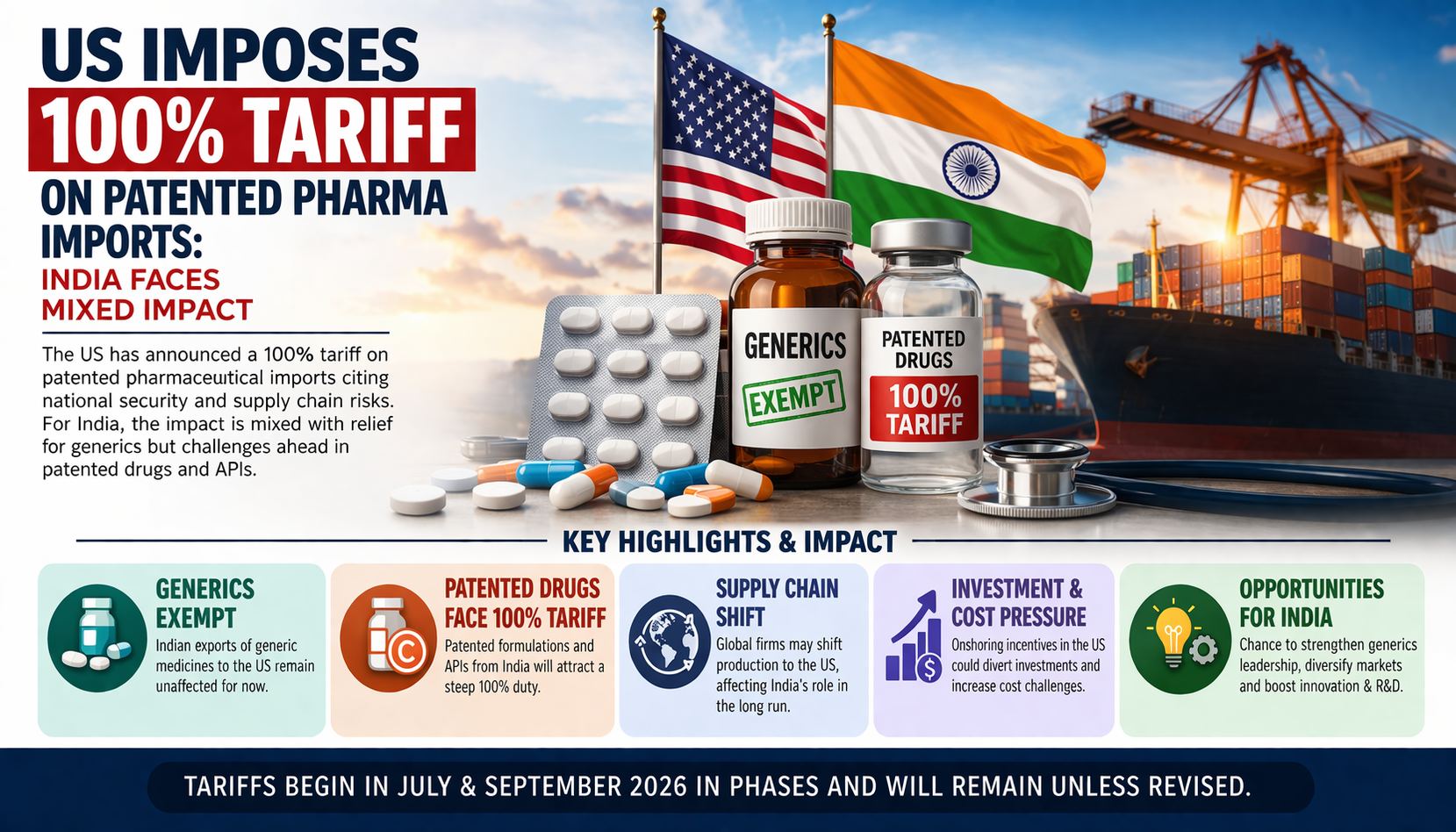
The global pharmaceutical landscape is witnessing a significant policy shift as the United States announces a 100% tariff on patented pharmaceutical imports. This move, driven by concerns over national security and supply chain vulnerabilities, has sparked widespread discussion across the healthcare and pharmaceutical industries. For India—one of the largest pharmaceutical exporters in the world—the impact is expected to be mixed, nuanced, and strategically important.
This blog explores the implications of this policy, its short-term and long-term effects, and what it means for the global pharmaceutical supply chain.
Understanding the US Tariff Decision
The US government has imposed a 100% ad valorem tariff on imported patented drugs and associated pharmaceutical ingredients. This decision stems from a broader investigation into supply chain dependencies and aims to reduce reliance on foreign manufacturing.
Key highlights of the policy include:
- Patented drugs and APIs (Active Pharmaceutical Ingredients) are subject to the tariff
- Generic medicines are currently exempt from these tariffs
- Implementation will begin in phases starting July and September 2026
- Companies shifting production to the US may receive temporary tariff relief
The core objective is to boost domestic manufacturing, enhance public health security, and mitigate risks linked to global supply disruptions.
Relief for India’s Generic Drug Exports
India holds a dominant position in the global generics market, particularly in the United States. The exemption of generic medicines provides a significant cushion for Indian exporters.
Why This Matters:
- Generic drugs account for a major share of India’s pharma exports
- The US is one of the largest markets for affordable medicines
- Indian companies are known for cost-efficient, high-quality generics
In the short term, this exemption ensures:
- Continuity in export volumes
- Stable revenue streams for Indian manufacturers
- Minimal immediate disruption in trade relations
This is a critical advantage, especially when global trade policies are becoming increasingly protectionist.
Challenges for Patented Drugs and APIs
While generics remain unaffected for now, the same cannot be said for patented drugs and pharmaceutical ingredients. The steep tariff introduces several challenges:
1. Increased Cost Pressure
Exports involving patented formulations or APIs may become less competitive due to higher costs.
2. Supply Chain Disruptions
India plays a vital role in contract manufacturing and intermediate supply. Tariffs could disrupt these interconnected supply chains.
3. Reduced Export Opportunities
Companies involved in patented segments may face declining demand from the US market.
Strategic Shift Toward Onshoring
A major objective behind the tariff policy is to encourage onshoring of pharmaceutical production in the United States.
Key Developments:
- Companies relocating manufacturing to the US may receive reduced tariffs initially
- Incentives for domestic R&D and production are expected to increase
- Over time, tariffs could rise back to 100% if reshoring commitments are not met
This signals a clear shift toward self-reliance in healthcare manufacturing, which could reshape global investment patterns.
Long-Term Implications for India
While the short-term outlook remains stable due to the generics exemption, the long-term scenario is more complex.
1. Investment Diversion
Global pharmaceutical companies may redirect investments toward the US to avoid tariffs.
2. Competitive Pressure
India may face increased competition if production shifts closer to end markets.
3. Policy Uncertainty
The exemption for generics is temporary and subject to future review, creating uncertainty.
4. API Ecosystem Impact
India’s role as a key API supplier could be challenged if domestic US production scales up.
Opportunities Amid Challenges
Despite the risks, this policy also opens up new opportunities for Indian pharmaceutical companies.
Strengthening Generics Leadership
India can further solidify its position as a global leader in affordable medicines.
Expanding into New Markets
Diversifying export destinations beyond the US can reduce dependency and risk.
Boosting Domestic Innovation
Increased focus on R&D and innovation can help Indian firms move up the value chain.
Strategic Partnerships
Collaborations with global players for joint manufacturing or licensing can mitigate tariff impacts.
Global Supply Chain Reconfiguration
The pharmaceutical supply chain is highly interconnected, and such policy changes often have ripple effects.
Key Observations:
- Over 50% of patented drugs in the US are currently produced abroad
- Only a small percentage of APIs are manufactured domestically
- The shift toward self-sufficiency could redefine global sourcing strategies
This transition may lead to:
- Regionalized manufacturing hubs
- Increased compliance and regulatory costs
- Greater emphasis on supply chain resilience
Conclusion
The US decision to impose a 100% tariff on patented pharmaceutical imports marks a pivotal moment in global healthcare policy. For India, the immediate impact is moderated by the exemption of generic medicines, ensuring stability in a crucial export segment.
However, the long-term implications demand strategic adaptation. Indian pharmaceutical companies must prepare for evolving trade dynamics by focusing on innovation, diversification, and global partnerships.
As the global pharmaceutical industry navigates this transformation, one thing is clear: resilience, adaptability, and forward-thinking strategies will define future success in this rapidly changing landscape.