
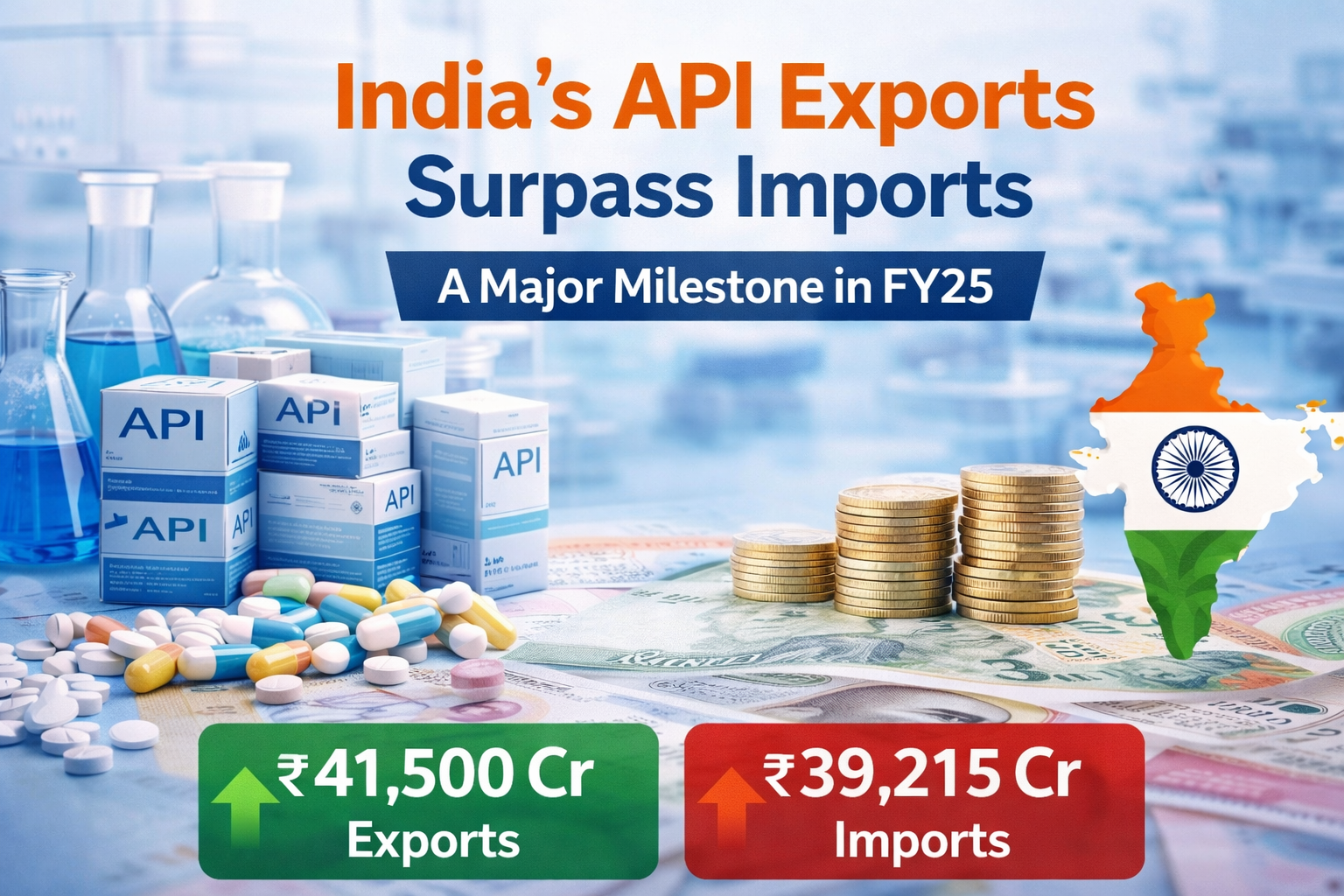
India’s pharmaceutical industry has achieved an important milestone with the export of active pharmaceutical ingredients (APIs) surpassing imports during the last financial year. According to recent data, the country exported APIs worth approximately ₹41,500 crore, while total imports stood at around ₹39,215 crore. This development reflects the growing strength of India’s pharmaceutical manufacturing sector and its expanding role in the global healthcare supply chain.
The achievement also highlights ongoing efforts to increase domestic production and reduce reliance on imported pharmaceutical ingredients.
Understanding Active Pharmaceutical Ingredients (APIs)
Active pharmaceutical ingredients, commonly known as APIs, are the core components responsible for the therapeutic effect of medicines. They form the primary substance in pharmaceutical formulations such as tablets, capsules, injections, and syrups.
Without APIs, medicines cannot deliver the intended medical benefits. Therefore, the production and availability of these ingredients play a crucial role in maintaining a stable pharmaceutical supply chain.
India is widely recognized as a major global supplier of generic medicines, and the growth in API exports further strengthens the country’s position in the international pharmaceutical market.
Growth in India’s API Exports
The rise in API exports indicates a positive shift in the pharmaceutical manufacturing ecosystem. With exports reaching approximately ₹41,500 crore, the sector has demonstrated its ability to compete effectively in global markets.
This growth is driven by several factors, including expanding production capacity, technological advancements in pharmaceutical manufacturing, and increasing demand for affordable medicines across the world.
International markets rely heavily on high-quality APIs produced in India due to the country’s strong manufacturing infrastructure and skilled workforce. As a result, pharmaceutical companies across multiple regions continue to source bulk drugs and intermediates from Indian manufacturers.
Rising Imports and Global Dependence
Despite the increase in exports, India still imports a significant amount of pharmaceutical raw materials and intermediates. Over the past few years, the value of API imports has gradually increased.
Imports were recorded at approximately ₹36,229 crore in 2022–23, which increased to ₹37,721 crore in 2023–24, and further reached around ₹39,215 crore in 2024–25.
A large portion of these imports comes from international suppliers, highlighting the global interdependence within the pharmaceutical supply chain. While India produces many APIs domestically, certain raw materials and intermediates are still sourced from overseas markets due to cost advantages and established supply networks.
This reliance on imports has encouraged policymakers and industry leaders to strengthen domestic production capabilities.
Government Initiatives to Boost Domestic Manufacturing
To reduce dependency on imported pharmaceutical ingredients, several initiatives have been introduced to encourage local manufacturing. One of the most significant programs supporting this goal is the Production Linked Incentive (PLI) scheme for bulk drugs.
This initiative aims to increase domestic production of key starting materials, drug intermediates, and APIs. By providing financial incentives to manufacturers, the scheme encourages companies to invest in new production facilities and expand existing manufacturing operations.
The program is designed to strengthen India’s pharmaceutical ecosystem and ensure long-term supply stability.
Expansion of Domestic Production Capacity
As part of these efforts, significant progress has been made in building domestic manufacturing capabilities for critical pharmaceutical ingredients. Production capacity has already been established for several important products identified as essential for the pharmaceutical sector.
This development is helping reduce import dependence while simultaneously boosting exports. Increased domestic production also supports supply chain stability, ensuring that manufacturers have access to essential raw materials even during global disruptions.
The expansion of production facilities has also contributed to economic growth by generating employment opportunities within the pharmaceutical industry.
Economic and Employment Benefits
The growth of the API manufacturing sector not only supports the pharmaceutical industry but also contributes to broader economic development. Increased domestic production encourages investment in infrastructure, technology, and research.
As production capacity expands, new job opportunities are created in manufacturing, research laboratories, quality control, logistics, and supply chain management.
Employment generation in the pharmaceutical sector plays a vital role in strengthening the country’s industrial ecosystem and promoting long-term economic growth.
Strengthening India’s Position in the Global Pharma Market
India has long been recognized as a global hub for pharmaceutical manufacturing, particularly in the production of generic medicines. The recent achievement of API exports exceeding imports further reinforces this reputation.
By expanding domestic production capabilities and improving supply chain resilience, India is gradually reducing its reliance on external sources for pharmaceutical ingredients.
This shift not only improves the country’s self-sufficiency but also strengthens its ability to supply high-quality medicines to international markets.
Future Outlook for the API Sector
The future of India’s API manufacturing sector appears promising. Continued investment in technology, infrastructure, and research will play a crucial role in maintaining the growth momentum.
Government support, combined with private sector innovation, is expected to accelerate the development of domestic production facilities. Over time, these efforts may significantly reduce import dependence and further increase export potential.
As global demand for medicines continues to rise, the need for reliable suppliers of pharmaceutical ingredients will also increase. With its strong manufacturing base and expanding capabilities, India is well positioned to meet this growing demand.
Conclusion
The fact that API exports have surpassed imports represents a significant achievement for India’s pharmaceutical industry. With exports reaching approximately ₹41,500 crore, the country has demonstrated its ability to compete effectively in the global pharmaceutical ingredient market.
At the same time, ongoing initiatives aimed at strengthening domestic production are helping build a more self-reliant pharmaceutical ecosystem. By expanding manufacturing capacity and reducing reliance on imports, India is moving toward a more stable and sustainable pharmaceutical supply chain.
This progress not only benefits the domestic healthcare system but also reinforces India’s role as a key contributor to global medicine production.