
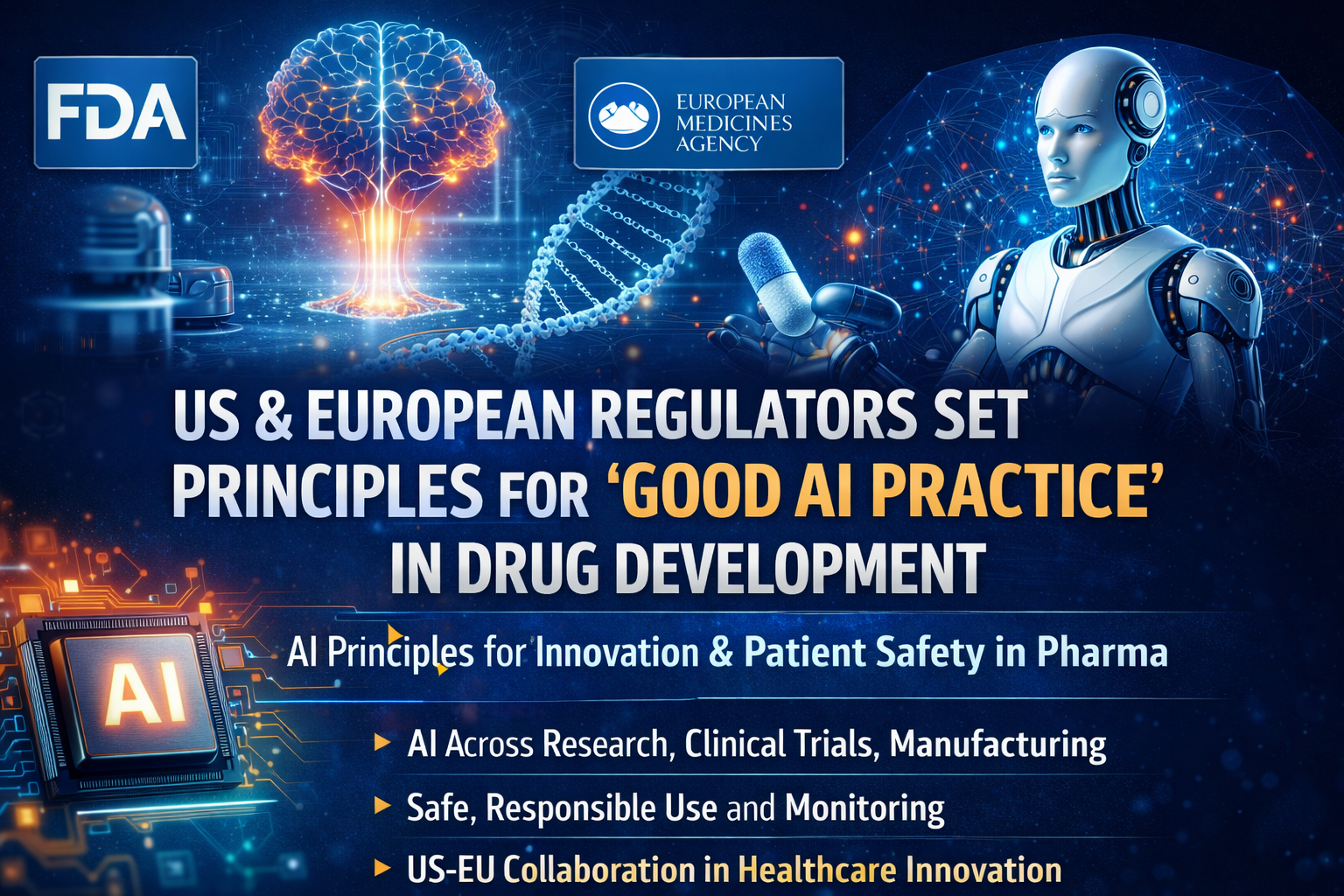
Artificial intelligence (AI) is rapidly transforming the global pharmaceutical landscape. Recognizing both its potential and risks, the US Food and Drug Administration (FDA) and the European Medicines Agency (EMA) have jointly issued a new set of principles outlining good AI practice in drug development. Announced on January 15, 2026, these principles aim to accelerate innovation while maintaining the highest standards of patient safety and regulatory oversight.
A Joint Regulatory Milestone in AI-Driven Drug Development
The FDA and EMA initiative represents a significant step toward harmonized global governance of AI in pharmaceuticals. The principles provide broad, lifecycle-based guidance on how AI systems should be designed, deployed, and monitored across every stage of medicine development, including:
-
Early-stage research and drug discovery
-
Clinical trials and evidence generation
-
Manufacturing and quality control
-
Post-marketing safety surveillance and pharmacovigilance
This collaboration follows a bilateral FDA–EU meeting held in 2024, reflecting a renewed commitment to joint leadership in healthcare innovation.
Core Focus: Safety, Transparency, and Scientific Integrity
According to regulators, AI should not be treated as a black-box technology. Instead, its use must be grounded in scientific rigor and accountability. The guiding principles emphasize:
-
Data integrity and reliability to ensure AI-generated evidence is scientifically valid
-
Transparency and explainability of AI models used in regulatory submissions
-
Human oversight in critical decision-making processes
-
Continuous monitoring of AI systems to detect bias, drift, or unintended outcomes
The objective is not only faster innovation but also trustworthy innovation, ensuring that AI tools enhance—not compromise—patient safety.
FDA and EMA’s Ongoing AI Initiatives
The FDA has already taken concrete steps by deploying a generative AI tool called “Elsa”, designed to improve efficiency across regulatory operations, including scientific reviews. This demonstrates how regulators themselves are adopting AI to handle increasing data complexity.
On the European side, the EMA is building on its 2024 AI reflection paper, with detailed guideline development already underway. These efforts align closely with the agency’s mandate to promote safe, responsible, and ethical use of advanced technologies in healthcare.
Strategic Importance of EU–US Cooperation
European Commissioner for Health and Animal Welfare Oliver Várhelyi described the principles as a “first step of renewed EU–US cooperation” aimed at preserving leadership in the global innovation race while ensuring robust patient protection. This statement underscores the geopolitical and economic importance of AI governance in pharmaceuticals.
As regulatory expectations become clearer, pharmaceutical companies worldwide will need to align their AI strategies with these evolving standards to remain competitive and compliant.
Growing Industry Adoption of AI
The regulatory push comes at a time when drugmakers are aggressively investing in AI-driven capabilities:
-
AstraZeneca recently agreed to acquire Boston-based Modella AI to accelerate oncology drug research.
-
Nvidia and Eli Lilly announced a $1 billion joint investment to establish a new AI-focused research lab in the San Francisco Bay Area over the next five years.
These developments highlight how AI is no longer experimental but central to modern drug discovery and development pipelines.
Implications for the Indian Pharmaceutical Ecosystem
While the principles are issued by US and European regulators, their influence is global. Indian pharmaceutical companies engaged in exports, innovation, or international collaborations will increasingly need to comply with such AI governance frameworks.
This evolving environment also creates opportunities for specialized business models, including collaboration with a monopoly medicine company in India that leverages data-driven innovation while maintaining regulatory compliance. Similarly, partnering with a pharma contract manufacturing company can help firms integrate advanced technologies without excessive capital investment.
Conclusion
The joint FDA–EMA principles on good AI practice mark a defining moment for the future of drug development. By balancing innovation with responsibility, regulators are setting clear expectations for how AI should be used across the pharmaceutical value chain. For companies that prioritize compliance, transparency, and patient safety, these guidelines offer a structured pathway to harness AI effectively. In this context, organizations like DM Pharma Global, with a forward-looking approach to quality, technology, and regulatory alignment, are well positioned to adapt to and benefit from this new era of AI-driven pharmaceutical innovation.